Showing posts with label obama. Show all posts

Wednesday, November 14, 2012

I Don't Approve My Tax Dollars to do That: Get Further Involved in the Middle East


“We’re not your grandfather’s America anymore”

Thomas Friedman is one of my favorite NY Times Op-Ed columnists. This week he posted an interesting column on what Obama’s reelection meant for the relationship between the United Stated and Israel.

According to Friedman, “Obama has his marching orders from the American people.” Such orders involve turning our attention back toward conditions at home rather than problems abroad. We want out of present conflicts and to stay out of future ones. Let someone else do the dirty work for once. For Israel, that ideology means “Don’t count on America to ride to the rescue.”
Photo credit: http://www.legendsofamerica.com/ks-hollenberg.html


Tensions have increased over the course of four years between the Obama Administration and the Israeli government. Prime Minister Netanyahu even openly supported Romney (that worked out well for you, Mr. Netanyahu, didn’t it?). Friedman dubbed such alignment with the conservative right wing as foolish on his part because that is no longer “the rising political force in America.” He would have been better off to associate and make friends with the Democrats. Oh wait, he already snubbed Vice President Biden.

A September 2011 meeting between President Obama and Prime Minister Netanyahu. The two have not always had the greatest relationship, particularly in regards to Iran's nuclear program. 
Photo credit: http://rt.com/usa/news/us-israel-iran-nuclear-773/

 But the biggest change is what we ourselves have realized about meddling in the Middle East: it doesn’t work so we need to stop trying. As Friedman writes,  “We can provide the mediation and even the catering, but it has to start with them.” We can no longer march into an area and demand obedience and respect. It is not fair to us, as our valuable tax dollars get sucked dry remediating another country’s conflict, and it is not fair to country we’re trying to support. They have to be able to support themselves. Assistance is one thing; becoming a nation’s military foundation is another.

Under the Bush administration, Americans were much more supportive of Israel, especially since we lacked powerful Middle Eastern allies. Under Obama, however, that support has shifted in favor of the Palestinians and increased the percentage of people who identified as neutral or no opinion.
Photo credit: http://www.californiapatriot.org/magazine/2009/09/the-special-us-israel-relationship-a-case-for-the-continued-support-of-israel/


The only America I remember is a nation at war. Now a legal voter, I have my own fair share of concerns that reside within our nation’s borders. I want affordable health care. I want an affordable college education. I hope someday to be able to achieve what I consider my version of the American dream. I cannot necessarily do that while my government squanders MY money away in the Middle East. It’s time my money and my president finally return home.

I don’t approve my dollars to do that: get more involved in the Middle East.


Sunday, November 11, 2012

After the Election: Why the Republicans Shouldn't Be So Surprised


The saying goes, “the winner takes it all.” The presidential election is no exception. Romney will be lost to the history books, quickly overtaken by the next GOP hotshot while Obama, his legacy already cemented with his election four years ago, will continue to make an impressive mark. But the election results did more than deny the GOP the position of commander-in-chief. They revealed that Party members are sporting a new accessory: earmuffs.

Yes, earmuffs.

In reading various articles after Election Day, much of the consensus reveals that despite their supposed shock, the Republicans would have seen the writing on the wall had they paid attention. Their reaction to Romney’s fairly decisive loss shows how much the Republicans were completely oblivious to the wants, expectations and actions of American voters. Michael Barone, co-author of The Almanac of American Politics, predicted a 315-electoral vote win for Romney. George Will called 321 for Romney. Karl Rove showed he was no more mature than a five year old, blubbering and throwing a tantrum on Fox News. How could they be so misguided?
 Map of Tuesday's presidential election results in each state. Florida has since officially awarded its electoral votes to Obama. The Republicans claim to be "shellshocked" by the devastating loss but Romney lost by over 100 electoral votes. Even with California, that is no small feat. Of six major  swing states, Ohio, Michigan, Colorado, Florida, Virginia and Iowa, Obama won 5, despite the many claims by Republicans to sweep the swing states. 
Photo credit: http://media2.abc15.com//photo/2012/11/09/electoral_map_cnn_20121109112711_640_480.JPG


I recommend two articles, the first a NY Magazine editorial and a NY Times blog (written by the Times ‘ Editor).

Both articles related that the Republicans’ isolated themselves in their own bubble, discrediting and faulting any source that predicted anything but a landslide win for Romney. By only acknowledging sources and reports that favored them, they tricked themselves into believing a fantasy. What I still don’t understand though is how this could happen on such a national level? The Republican Party is one of two main political parties in the United States. How could they be so out of touch with the 2012 voters?  
In googling images for the map of the electoral college by state, this came up. The author wanted to show the election results if white men, the key Republican demographic, were the only ones allowed to vote.. No surprise that forty-five of the fifty states went red, even die-hard blue California. Thankfully, white men are not the only ones allowed to vote. It's time for the Republicans to acknowledge that.
Photo credit: http://minnesota.publicradio.org/collections/special/columns/news_cut/archive/2012/11/if_only_white_men_could_vote.shtml

One source I read immediately after the election described your typical Republican: white and male. The problem with targeting that particular demographic is that its control on political power is declining with the rise of women and minority voices. The shocking and completely infuriating dismissal of rape by Todd Akin in August, for example, was just one sign of how out of touch the Republican Party is. If he truly felt like he could openly say that and not start a riot (or more importantly lose him the election), then that shows the Republicans have a real problem. Guess what? He lost in Missouri to a Democrat.

It baffles me. Top party leaders are supposed to be astute, savvy and clued into the talk of the nation. We tried to inform them but the Republicans cut their communication lines. It’s not our fault they got handed a defeat. The voters did our job. Now, rather than whine like a group of preschoolers, they ought to re-evaluate who who today’s Republicans ARE. Plural. If the Republicans continue to limit themselves to the rich white man’s club, they’re going to keep losing. Maybe we’ll witness the a rise of new political parties.


Wednesday, November 7, 2012

My Thoughts on the Outcome of the Election


After months of intense campaigning, Obama emerged as the projected victor of the 2012 US presidential election. I care about the outcome of the presidential race, but there were three other contests, four including my own state’s senatorial race, whose outcomes worried and excited me almost as much as that for president. They were the ballot votes on gay marriage in Maryland, Maine and Washington.

What is unique about this particular ballot vote is that it had never before succeeded. Massachusetts, Iowa and the other four states that currently allow same-sex marriage were not decided by a popular vote: their courts deemed such discrimination unconstitutional. When attempting to pass same sex marriage via the popular vote, even Maine shot the proposition down 53% to 47% several years ago (http://bruni.blogs.nytimes.com/2012/11/07/maine-and-maryland-say-we-do/).

Now in 2012 things are starting to change. Obama is the first president to openly support gay marriage. Maryland and Maine passed gay marriage in their respective states with promising results thus far predicted for Washington (their submit their ballots in the mail so actual numbers take longer to determine). Wisconsin elected the first gay senator, Tammy Baldwin. To me, these results symbolize a change in attitude in the American population. People have finally realized that the failure to include all people and families in law is flat-out discrimination, religious preferences and propaganda aside. It’s acknowledgement that we are not so different after all and do not deserve to be denied our rights.

There is still a lot of work to be done. Thirty states have banned gay marriage in their constitutions. But if the number of states allowing gay marriage can jump from six to nine states overnight, there may just be hope that those numbers will be reversed by the time by moms turn 65.

Thank you, American voters, for supporting my family last night.  

Tuesday, November 6, 2012

I Don't Approve My Tax Dollars to do That: Free-for-All Military Spending


In the United States, the first Tuesday in November is probably the most famous day of the month in the United States behind Black Friday and Thanksgiving. That day, which happens to be today, is Election Day. By the end of the night, we [hopefully] will know our leader of the next four years, if voting goes as planned. We shall see if that actually pans out.

Although both presidential candidates have attempted to distinguish themselves over the course of the campaign, portions of their policies line up with one another. One example is that Obama and Romney have both promised to increase the defense budget. As a twenty-year-old with residual resentment about the Iraq War, I’m tired of hearing out expansion of military spending. Problems here at home need urgent attention too, not just those abroad. Imagine my surprise when I read an article posted by my politics professor in which a Marine reserve officer actually agreed with me.

Huh?

In his op-ed column for the New York Times, Aaron B. O’Connell compares our country’s present relationship with the military to that at the end Eisenhower’s presidency. Eisenhower warned of the military becoming too large of an influence in political and domestic affairs, becoming a epicenter around which all other policies would circle, defense-related or not. He pointed out that few of his Naval Academy students remember when America was not at war. I cannot say I recall when a time bombings, death tolls, yellow ribbons and camouflage were not daily contributors on the nightly news. O’Connell claims that service is glorified in the media through television shows and video games. Various military-related demonstrations precede major sporting events. When did we, the civilian population, become so obsessed with our nation’s unequivocal military might?

Particularly popular after 9/11 and the immediate outbreak of the Iraq War, the yellow ribbon, a symbol of supporting the troops and thus being a "good" American, is seen everywhere from trees to cars to businesses. I remember in 5th grade tying yellow ribbons around tree trunks outside of my elementary school in 2003. Now such practice in a public school would bother me. We ten and eleven year olds were not given an option not to support our troops. We just did. In essence we were brainwashed: that the military going to war was a good thing. War is never a good thing. 

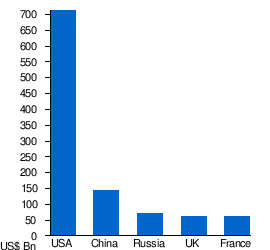
How much the US devoted to military expenditures in 2012 compared to the world's other leading nations. The sum of China, Russia, the UK and France's spending barely exceeds half of what the US alone spends in a year. How much of what we spend is really necessary? 
Photo credit: http://en.wikipedia.org/wiki/List_of_countries_by_military_expenditures

The most interesting aspect of O’Connell’s op-ed however was his critique of the excessive military spending. I assumed that as an officer he would be all for more money and resources. He is not. In fact, he calls for increased skepticism and criticism from Congress. The majority of representatives and senators have no military background, trapping them in a dangerous Catch-22: criticize the military without the proper credentials and be deemed un-patriotic or provide “unhesitating adulation” and allow military spending to balloon out of control. Guess which choice leads to re-election (http://www.nytimes.com/2012/11/05/opinion/the-permanent-militarization-of-america.html?ref=opinion).

The concept of trade-offs in terms of spending often gets lost among political jargon and election ads. When we appropriate funds for one project, another project inevitably loses them. We devote more money to the military, chances are that gets taken from other areas at home. Instead of working to pay off the deficit, we build more tanks. Rather than reduce the cost of a higher education, we establish more bases. Money does not just magically appear; it all comes from somewhere and more importantly, it is a finite amount. Regardless of the outcome of today’s election, I hope our next president will weed out the military budget with the guidance of those who know the industry best. It’s time we bring the troops and the money home.

Increased military spending for the few years after the 9/11 attacks does not come as a surprise. But ten years after the fall of the Twin Towers, why are we still increasing the budget? 
Photo credit: http://en.wikipedia.org/wiki/File:U.S._Defense_Spending_Trends.png 

I don’t approve my tax dollars to do that: free-for-all military spending  

Wednesday, October 31, 2012

I Approve My Tax Dollars to do That: Provide Natural Disaster Relief


I know most of my recent posts have related to things I approve or need my tax dollars to do. Although I originally planned to write this post about an expenditure I do not approve of, I was so appalled by what I read in this NY Times editorial that I needed to share it.

When a natural disaster like Hurricane Sandy strikes the United States, a federal body called the National Response Coordination Center heads recovery efforts. The umbrella organization of the Federal Emergency Management Agency (FEMA), the Coordination Center decides how to allocate and distribute various forms of aid. It also assists with any evacuations. As a federal body, it has vast resources and authority at its disposal. Furthermore if states are already distressed or without means of communication during or after a storm, it is one fewer things the state has to deal with. The state is already in enough trouble; it should not have to orchestrate aid efforts as well.

Flooding of the subway system has brought New York City to a standstill: schools are closed, Wall Street vacant, hospitals evacuated and people trapped in upper-story apartments without power. Under Romney's plan, how is a state capital under water supposed to coordinate an effective emergency response without power and transportation? 
Photo credit: http://inhabitat.com/nyc-public-transit-system-crippled-after-hurricane-sandy-causes-widespread-flooding/ 

Romney, however, wants to eradicate the National Response Coordination Center and shift emergency management not even to the states but to the private sector. Consequently “profit-making companies,” rather than the federal government, would control the emergency response. Because it makes a lot of sense to have people’s safety, evacuation and aid be in the hands of businesses out to make a buck. Who’ll get the bottles of water, blankets and protein bars? Those who can pay for it.

Yes, because Massachusetts expect to experience hurricane-strength storm surges and thus it's our fault the coastline got slammed. (Winthrop, MA)
Photo credit: http://www.nydailynews.com/news/hurricane-sandy-strikes-east-coast-gallery-1.1194577 

The author, whose name was nowhere to be found on the editorial itself, explained why Republicans despite nationally-overseen emergency management: “Many don’t like the idea of free aid for poor people or they think people should pay for their bad decisions, which this week includes living on the East Coast.”

Excuse me!?  

Hurricane Katrina crippled Louisiana. The West confronted massive wild fires all last summer and into the fall. Tornadoes rip through the Midwest. Earthquakes vex the West Coast. Blizzards shut down much of the North. Every part of the country experiences some form of natural disaster; there is no “safe” state. A natural disaster is no one particular person’s fault. Yet when their states get affected, they come crying for federal aid and financial assistance. How totally hypocritical. You don’t want federal aid? Fine, then don’t take it. See how effective the response is. Like health care, emergency management is not something that belongs in the private sector. It belongs to the federal government.

Even the city that never sleeps is no match for a hurricane. 
Photo credit: http://www.theatlantic.com/infocus/2012/10/hurricane-sandy-after-landfall/100396/

I approve my tax dollars to do that: fund FEMA and the National Response Coordination Center.


Sunday, September 23, 2012

Follow Up: Elephant Poaching and the Ivory Trade


“It is difficult to know exactly how many people have died.”

This weekend the New York Times posted another article about elephant poaching and the ivory trade. While not an extension of the article described in my blog post from September 12th, it does further investigate the consequences of such a lucrative “sport.” The author of the Op-Ed column, Louisa Lombard, examines the loss of human life in addition to that of the majestic elephant.

The spoils of an ivory seizure in Kenya. The 1,550-plus pounds of ivory, valued at an approximately $750,000 US dollars, was guessed to have come from 50 adult male elephants. DNA testing can be used to determine from where the elephants had originated. 
Photo credit: http://www.awf.org/blog/huge-ivory-seizure-two-men-arrested/ 

One of the most sobering figures in her article is the lack thereof. As the first line of this post implies, no one knows exactly how many people have lost their lives by getting involved on either side of the war for ivory. Some groups keep track of how many guards are lost. No one even attempts to record the number of poachers killed.

What can be done to effectively stop the slaughter of both human and elephant life in the name of ivory? Lombard acknowledges that “human management” of the crisis (ie wildlife conservation) is relatively futile. She instead claims that, “curbing the demand for ivory is, in the end, the only way to curb both elephant and people life.” Yet I do not understand how such reduction in demand is possible. The countries with the highest demand for ivory cherish it for its religious connotations, not its construction properties or beauty.

Intricately carved ivory religious figurines. The notion that ivory honors God is evident in Buddhism and Catholicism.
Photo credit: http://newswatch.nationalgeographic.com/2009/06/19/illegal_ivory_trade_in_thailand/

Asking the Chinese to relinquish their love of ivory equates to asking Americans to omit “one nation under God” from the Pledge of Allegiance: it’s simply not going to happen.

I wholeheartedly support freedom of religion (though I myself am unreligious). But in a situation like this, where religion is tied up in other global conflicts, I feel hypocritical. Pretend such ivory demand existed in the United States. I believe I would advocate for regulations restricting the import and sale of ivory, whether it be used for religious purposes, piano keys, trinkets, etc in order to protect the elephants. But if ivory is believed by some religions to honor God, then are restrictions on its import and sale a violation of the First Amendment? Is asking a person to reconsider what he or she uses to honor God imposing upon his or her religious freedom? To me, it feels like it does.

In that case, how do we attempt to balance the two?  One solution I thought of was using elephant meat to feed starving villages. At least in that respect, the death of an elephant serves a bigger purpose than fueling the ivory trade. Yet that solution fails to protect elephants as a species and inevitably would create a whole assortment of other problems.  No answer will be the perfect solution. Sadly, more humans and elephants will have to die until that solution emerges.


Monday, September 17, 2012

Should I Approve My Tax Dollars to do That: Import Health Care


While most career fields in the United States experienced job loss during the recession, the health care sector added 1.2 million jobs, a lone “bright spot in the economy”. Yet an NY Times Op-Ed Column alerted me to a disheartening reality. To fill the demand for new health care professionals, we are not educating and employing our own. Instead, we are importing them.

The demand for more health care workers arose in part from changes imposed by Obama’s Affordable Health Care Act and the aging of the Baby Boomers.  However, American medical schools have not responded with an increased output of M.D.s. They still reject hundreds of thousands of qualified applicants while we fill the need for doctors by importing foreigners who now comprise twelve percent of the health work force. In 2011-2012, 43,919 students applied to US medical schools. While that number does not differentiate between domestic and international students,  only 19,230 students actually matriculated (https://www.aamc.org/download/153708/data/charts1982to2012.pdf). The author of the Times article, Kate Tulenko, argues that in doing so, we are also taking doctors away from the areas that really need them. Countries where twenty percent of children die before their first birthday should not be losing health care workers to the United States. Leave those doctors to do a job that for many is a matter of life and death and start increasing the production of our own.

As someone pursuing a career in medicine, the ability to get into (and consequently pay for) school is a big concern. Though I plan to enter veterinary school, applicants across pre-health fields face the same dilemmas of completing mile-long lists of requirements, achieving impossibly high test scores and GPAs in order to be competitive and extraordinary volunteer work, extracurricular activities, internships or research so yours stands out among the myriad of applications. Such glitter, if you will, often requires two things: money and connections.
 Politics and financial status should be irrelevant when it comes to health care. Good health care entails a patient and his/her doctor devising preventative, maintenance and recovery plans that best suit the patients needs. Yet a paper application ignores that necessary quality. For example, it is pointless to prescribe insulin to a diabetic patient in rural Mississippi if she does not own a fridge to store it in. The doctor must figure out a more creative, unorthodox approach. She (the patient) frankly will not know or care if her doctor had a 4.0 GPA as an undergraduate or achieved a perfect score on the MCAT. She will just want to feel better.


I wholeheartedly support the exchange of techniques, theories, and developments across nation lines. But I have a real problem with the fact that the US has imported and is importing tens of thousands of health care workers while there are thousands more already here ready to take the Hippocratic oath. The Federal Government needs to apply more pressure on medical schools and state regulators to increase the number of teaching hospitals, increase class size and reduce the cost of a health profession education. Everyone has the right to adequate health care. But first, they need access to the people. Thus even before we facilitate the access, we need the people.

So in asking myself whether I approve my tax dollars to import health care, my answer is no. I want more of my tax dollars devoted to encouraging the education and output of American health care workers.

Think about it: what do you want from your doctor? 

Saturday, September 15, 2012

I Approve My Tax Dollars to do That: Prevent Another Attack


It is no secret that the illegal drug trafficking persists between Latin America, the Caribbean, South America and the United States. From breast implants to teddy bears, smugglers have concocted creative guises to evade authorities and shuttle drugs across nation borders. Now a new even more covert courier has emerged: a fully submersible submarine.

Described as “the Super Bowl of counternarcotics” by Commander Mark J. Fedor of the Coast Guard in a recent NY Times article, these aquatic crafts have been increasingly detected in the Caribbean within the last year.  Semi-submersible submarines are not rookies in the narcotics game; it is their fully submersible cousins that are now startling and worrying authorities. Only required to surface at night to recharge their batteries off the onboard diesel engine, they can travel underwater and therefore virtually invisible from South America all the way to the United States.

In addition to the challenge posed by their imperceptibility, authorities also face the problem of the submarines’ increased carrying capacity compared to their predecessors. The more commonly employed high-powered fishing and leisure boats can transport approximately one ton of cocaine. The fully submergible vessels, meanwhile, can haul upwards of ten tons, which are then ferried to shore by small boats once in shallow enough water.

Of the potential drug shipments identified by the Joint Interagency Task Force South, the group at the helm of American counternarcotic efforts, only one-fourth is ever intercepted. Manpower, aircrafts, and ships simply cannot respond to every shipment. Increasing the number of shipments seized involves working with local South and Central American authorities to prosecute the drug trafficking networks.

But there’s another unique aspect of these fully submersible submarines weighing on the minds of American authorities: the potential use of these vessels by terrorists to transport attackers or weapons. Though such use of submersibles by militants has yet to be detected, no one though a bomb could be smuggled through airport security in someone’s shoes or in a Gatorade bottle (for fact citations, see NY Times article above). Obviously air travel is a much more popular method of travel by the typical citizen, as 48% of adults in the US having flown for business or leisure in 2009 (http://www.ustravel.org/news/press-kit/travel-facts-and-statistics). But it seems both naïve and careless not to protect our ports and coasts from an attack. The United States has been caught unprepared twice within the last 75 years. I personally do not want to see another terrorist attack in my lifetime.

The $15 billion Obama allocated toward combating the drug war in 2010?  (http://www.msnbc.msn.com/id/37134751/ns/us_news-security/t/us-drug-war-has-met-none-its-goals/#.UFSiNu0ZdSo). Yes, I approve of my tax dollars going toward that if it means combating these sneaky submarines.


Saturday, September 8, 2012

At The Trailhead


Two months out from the November presidential election, it seems as though all anyone can talk about is the campaign. Engaged in a transcontinental game of “he said, she said,” both Obama and Romney pledge reforms neither can realistically make while they simultaneously denounce their opponent and his party. Scanning the headlines on NYTimes.com yesterday, I saw election coverage, election coverage and what a surprise more election coverage. Thus I wanted to take this opportunity to remind Mr. Obama and Mr. Romney (as well as the American media) that there is more going on in September 2012 than who will next inhabit the White House. 

Exasperated, I clicked on the “World” tab and browsed the article titles, finally settling on one that fell under the “Most E-mailed” category. The five-page article, Elephants Dying in Epic Frenzy as Ivory Fuels Wars and Profits, revealed the disturbing escalation of violent elephant poaching as a result of increased demand for ivory in Asia. I’ll expand upon my thoughts about the article in the next post but in the meantime, check out the full article here. Most upsetting to me however wasn’t the loss of elephant life: it was the fact I’d indirectly facilitated it.  More specifically, it was my tax dollars designated to support underfunded ally African governments that enabled the deaths of hundreds and hundreds of elephants for their precious tusks.

That’s funny…I never approved my dollars to do that.

            This November, I will join the many previously ineligible voices in casting my first vote in a presidential election. With Election Day rapidly approaching, it is our responsibility to be educated voters.  As part of an assignment for my World Politics class at Mount Holyoke College, I’m making it my mission to investigate and track down my federal tax dollars on all seven continents. Where exactly do they go? Who benefits from them? Do people actually benefit from them? Are the recipients really deserving of aid? And most importantly, where do I want them to go?
 photo credit: http://www.jessehora.com/index.php?/ongoing/somethin-somethin-series/