Showing posts with label United States. Show all posts

Sunday, November 18, 2012

I Don't Approve My Tax Dollars to do That: Fight another Civil War.


There are times I honestly believe our nation is led by groups of toddlers. States calling for secession following Obama's reelection is one of those times.

We went over this in 1860. A state cannot secede from the Union. Just because you disagree does not give you the right declare yourself as your own country.


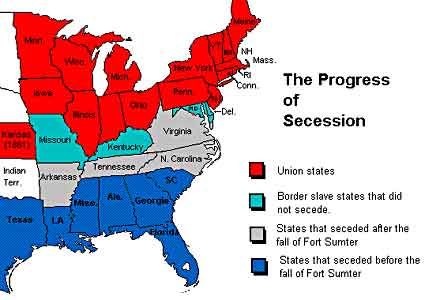
The states in dark blue seceded when Lincoln was elected. They did not listen when he vowed not to dissolve or prohibit slavery. They simply assumed the Republican elect would and thus left the Union. At least this time the states have witnessed Obama in office for four years.  In a way, it's a little surprising to me how so much of the Civil War was fought on and devastated Southern land and yet Southerners persistently call for secession. This time they are joined by several northern even die-hard blue states but it makes one wonder, have you already forgotten how bad the Civil War was? 
Photo credit: http://www.ushistory.org/us/32e.asp


Petitions have been filed to the “We the People” website on behalf of twenty states: Alabama, Arkansas, Colorado, Florida, Georgia, Indiana, Kentucky, Louisiana, Michigan, Mississippi, Missouri, Montana, New Jersey, New York, North Carolina, North Dakota, Oregon, South Carolina (shocker), Tennessee, and Texas (no surprise there).


Don't get married if you threaten divorce every time things get rough or you fight. Same thing with being part of a nation. 
Photo credit: http://www.reasonstosecede.com/whatissecession.shtml


He won the popular vote AND the Electoral College. Get over it.

Citing the Declaration of Independence, secessionists believe that it is their right to abolish and institute new government if they feel the government has failed to uphold its responsibilities (http://www.cbsnews.com/8301-250_162-57548572/states-petition-to-secede-from-union). My inner history major would like to point out that while the Declaration is an extremely important document, we govern ourselves according to the Constitution. Therefore the Constitution has the final say on secession. And as we determined 150 years ago, secession from the Union is unconstitutional. Done. End of story.


The We the People site allows people to communicate with the White House and submit petitions for things that they would like to change or see changed. Petitions that receive 25,000 signatures within a 30-day deadline will be reviewed. Texas' plea for secession currently has 22,000. They have until December 9th. 
Photo Credit: http://www.politico.com/news/stories/1112/83776.html

I am sick and tired of hearing dissatisfied people automatically crying secession instead of trying to fix the problem. If you are really that unhappy with the direction of the government, run for office. Volunteer for a campaign. Get involved on various committees. Actively work to change things instead of throwing in the towel and declaring you’re better off on your own. Much of our nation’s greatness stems from our disagreements. It is remarkable that so many people have different political philosophies yet can get together and govern a nation. We sacrificed so much to be a nation – why throw that all away?


In my history class last semester, we discussed why Washington differed from the other Virginia elite. He sought a larger government with more authority and a federal military while many of his fellow Virginias favored a much smaller government and fewer taxes. My professor, Joseph Ellis, pointed out that Washington saw first hand why a big government was necessary. His officers and many of the men who fought were Northerners. They needed soldiers and supplies but the government did not have the power to authorize and distribute them effectively. It’s time the Southerners remembered the sacrifices the North made to make this nation a reality. If we can be scrappy Yankees taking on the leading military power in 1776, we’re not going to give up that easily in 2012 either. 

I don’t approve my tax dollars to do that: fight another civil war. 

Sunday, October 7, 2012

I Approve My Tax Dollars to Do That: Build Whiskey-Powered Cars


I had heard about electric cars and hybrids, the occasional solar power van and even cars fueled by biodiesel. But a car that runs on whiskey? That was a new one.

To those appalled at the thought of precious Scottish whiskey being expelled through an exhaust pipe instead of consumed, breath easy: whiskey itself will not be used as the biofuel. Founder of Celtic Renewables Ltd Martin Tangney has uncovered a way to produce biobutanol, the main component of biodiesel, from by the by-products of whisky. Draff, the remnants of grain after fermentation, and pot ale, the residue from the still, are the two main sources of waste from whiskey production. Currently the draff and still are dumped into the sea, recycled into animal feed or used as a form of fertilizer on agricultural fields.

Commenting to Bloomberg, Tangney remarked, “If we can get this right in Scotland, we can adapt it anywhere. India makes whisky, Japan makes whisky, Ireland.  And Cognac uses a similar process. A lot of waste ends up in the sea.”

"Biodiesel is biodegradable as sugar and less toxic than table salt" 
Biofuel cars release significantly fewer carbon dioxide emissions per mile than gasoline-powered, diesel-fueled and even electric cars. Fewer emissions means cleaner air in cities and less environmental repercussions. "Biodiesel is biodegradable as sugar and less toxic than table salt" 
Photo/Quotation credit: http://www.incadventures.com/about/biodieselinfo.htm 

Scotland itself deserves some of the accolade for the motivation behind biofuel innovation and production in the country. Aiming to turn itself into a “renewable energy hub,” it hopes to supply 100 percent of its electricity need by renewable resources including wind, water and marine sources by 2020. In eight years, Scotland plans to jump from 35 percent to 100 percent (http://www.bloomberg.com/news/print/2012-10-04/whisky-to-fuel-cars-as-professor-drives-recycling-plan.html ).

That is quite an ambitious goal.


 Coffee is another commonly consumed beverage that has waste products suitable for biodiesel production with relatively ease. An extraction with hexane/ether is something I did in an undergraduate organic chemistry laboratory. If we already make large volumes of a substance, why not recycle the by-products to do something else? 
Photo credit: http://scienceblogs.com/gregladen/2008/12/16/coffee-as-a-source-of-biodiese/

With such a stake and dependence on big oil companies, the United States would never dare make such a bold proposition. In 2011, about 9.3 percent of the total United States energy consumption and 12.7 percent of electricity generation came from renewable energy sources. The EIA, the US Energy Information Agency, bragged that the former percentage was the “largest share of energy consumption since 1950” and the latter “the largest share of electricity generation since 1984” (http://www.eia.gov/tools/faqs/faq.cfm?id=92&t=4). It is extremely discouraging that the 2011 figures can only be shone in positively light by comparing them to sixty and twenty-five year old statistics. If so much can be done, why are my tax dollars going toward an extraneous war in the Middle East when they could be trying to rival Scotland’s 100% renewable energy goal? Scotland is not addicted to fossil fuels the way the US is. Until we decide to break that addiction, our renewable energy technology will continue to lag behind other countries.

In the United States, it would cost between $0.51 - $0.70 to produce a liter of biodiesel. Though the costs of labor, transportation, electricity for the plant, and other equipment have yet to be factored in, the availability (and cost) of biodiesel does not depend on conditions halfway across the globe. I was unable to track down a figure on the cost to product 1 liter of unleaded regular to compare the two. 
Photo credit: http://origin.arstechnica.com/news.media/BiodieselMap.jpg 

I approve my tax dollars to do that: fund the development of biofuel-powered cars.


Wednesday, October 3, 2012

I Don't Approve My Tax Dollars to do That: Mix Guns and Education

Guns have a place. They belong in gun clubs, shooting ranges, private homes for self-defense and in the hands of law enforcement. But according to the Colorado Supreme Court, guns now have another locale: the college classroom.

In March, the Colorado Supreme Court overturned a college-wide ban prohibiting firearms, claiming that  such a ban violated students' Second Amendment rights. The decision enabled students to bring their guns practically anywhere on campus. From class to the library to the dining hall, students with concealed weapon permits are now permitted to haul their guns around alongside textbooks and gym bags. CU did implement several restrictions on where guns can and cannot go. They are forbidden at sporting events and in regular dorms. Students with permits who wish to bring their guns to campus, something the school strongly discourages, are housed with graduate students (http://www.npr.org/2012/08/23/159921428/u-of-colorado-to-students-no-guns-in-dorms-please) Bans on visible guns, knifes and explosive remain unchanged. (http://articles.chicagotribune.com/2012-08-17/news/sns-rt-us-usa-firearms-coloradobre87h00h-20120817_1_boulder-campus-graduate-student-guns). In addition to the school's sanctions, Colorado law mandates anyone seeking a concealed weapons permit must be 21 or older. (http://www.npr.org/2012/08/23/159921428/u-of-colorado-to-students-no-guns-in-dorms-please) 

The changes came into effect as students returned to campus this past August. The Supreme Court's decision has sparked a rift between the University and the professors, many of whom shudder at the thought of students bringing concealed weapons to their classes. Some have threatened to cancel class in protest. The University however, has forcefully retaliated, admonishing professors who have expressed their resentment and made such threats. The administration claims that such decisions are not the professors call. Furthermore, it states that refusal to comply will be in violation of Colorado state law. http://www.huffingtonpost.com/2012/08/22/cu-boulder-chancellor-peterson-guns-on-campus_n_1822550.html 


Map of demonstrating which states ban guns from campuses, which permit their schools to decide, and which always allow guns. I was surprised to see that the "banned" states and "decide" states did not necessarily correlate to the conservative red versus liberal blue state map. I was especially surprised to see that Texas, Georgia and most other Deep South states had banned guns from college campuses.
photo credit: http://downloads.thedaily.com/ui-images/2012/08/18/081812-news-concealed-carry-map-r-662w-at-1x.png

If I were a student at Colorado University and I were financially able, I would hands-down transfer to another school. I am repulsed at the thought of my peers bringing guns to class. I would be afraid that someone might come after me if I made a provocative comment (said in a tactful, intellectually-stimulating way of course). Class would become more stressful than it already is, as I would replay the Aurora shootings in my head. This time, however, the setting being a lecture hall as opposed to a movie theater. 

It saddens me to think that students feel the need to protect themselves with a concealed weapon on a college campus. College is supposed to be a safe haven for learning and provide us with holy grail of education  resources and stimulation. College students are already stressed. We do not need to add the fear of getting shot by our classmates in a lecture hall, dorm, gym, or dining hall to the omnipresent  academic pressures.We do not need to worry about getting hurt for a controversial comment made in class. In my opinion, no guns on campus - period. 

Some will argue that since shootings occur on college campus (VTech), students should be able to defend themselves. This argument can be applied to any of the shootings in the thought that, "If I have a gun, I can protect myself." Is one person's right to protect himself or herself worth more than another individual or group's right to feel secure in a supposedly safe setting? Can guns have a "safe" place in the classroom and not interfere with student learning environment? Should we all carry concealed weapons? 

Tuesday, October 2, 2012

Romney and My Tax Dollars


Opening Safari this morning, I noticed that my homepage, nytimes.com, displayed an intriguing headline: "The Mitt Romney Who Might Have Been"

Huh?

He’s the Republican presidential candidate and a former governor. He is already a very well known and publicized figure. As such, most if not all Americans around or above voting age know his name. What else could he have been? Curious, I shoved my current homework aside, clicked on the link and began to read.

In a two-second summary of the article, author Robert Draper evaluated Romney’s role as an informal McCain advisor during the 2008 race and his performance as Massachusetts governor. The point? Romney aimed to please.

I highly recommend reading it if you wish to see a preview of President Romney. 

Rather than remain steadfast to his promises or convictions, Romney preferred to go along and do what would win him support and favor. A perfect example of this is his revelation about Roe vs. Wade. Once the potential of a presidential campaign emerged mid-way through his term as governor, his position on a woman’s right to choose reversed from support to opposition. His loyalty never lay with Massachusetts. One of his environmental officials told the Times, “Clearly, in retrospect, he was weighing what was right for Massachusetts with how it would play nationally." (nytimes.com) 

Melanie's Law, a law targeted at getting more drunk drivers caught repeatedly off the road, is seen as one of the big success stories of Romney's term as Massachusetts governor. While it has been successful at getting repeat offenders off the road, seeing as it was introduced as a result of the tragic death of a young girl by a repeat offender drunk driver, there was little political resistance to its enactment. IID stands for ignition interlock device: you must blow into it and pass or else the car will not start. 
photo credit: http://www.mass.gov/rmv/rmvnews/2008/iid_removals.gif

Now imagine a president weighting what was right for the United States with how it would play on the international stage. Not good. 

I do acknowledge that the Times tends to lean toward the left and therefore this evaluation of Romney is somewhat biased. However, as a Massachusetts resident, much of its criticisms about his performance ring true. Who wants a governor who spends the last two years of his term away forwarding his own presidential campaign? Should he get elected, will he spend the latter years of his term focused on his re-election campaign instead of our nation’s current crises? I want my president here and actively engaged in the needs of the United States. I want him to take a decisive stand on issues and not allow his hopes for re-election to taint his decisions. He must preside in the present: not in the prospects of the 2016 race.

Funny how he approved a similar health care system in Massachusetts that took effect while he was governor that is viewed as one of his other big successes and he now rejects such a system on a nation-wide scale. You no longer hear Bostonians complaining about the state-wide health insurance requirement. Massachusetts also has some of the best health statistics in the nation. 
Photo credit: http://s.wsj.net/public/resources/images/OB-TO311_0628sc_G_20120628120827.jpg

Obviously the 2012 presidential election is a huge determinant in the future of my tax dollars over the course of the next four years. I make no secret about the fact that I am a liberal: I favor big government, I support a woman’s right to choose and I applaud universal health care. But in some ways, I view myself as a fiscal conservative. I dislike when my hard-earned tax dollars are wastefully and ineffectively spent. I especially grapple with the concept of welfare systems. My philosophy is simple: live within your means. If you fail to do so, then that is your financial problem, not mine and certainly not my tax dollars’.

That being said, obviously I will not vote for Romney.  But in addition to our ideological differences, I do not trust him to be responsible with my tax dollars because he flip-flopped so many times on issues and policies as governor. If elected president, which Romney are we actually going to get?


Wednesday, September 26, 2012

Should I Approve My Tax Dollars to do That: Learn from Iran


In 2001, my mom described her health care philosophy to the Boston Globe: "Medical care is ideally broad enough to envelop not only the technical part of treating an illness, but caring for the whole animal - and the family around it.”


Though my mom’s expertise pertains primarily to animals, Dr. Aaron Shirley shares a similar sentiment about human patients. In 2010, Shirley founded HealthConnect, a rural Mississippi medical provider that provides a “holistic, intensely personal approach” to patient care. His inspiration for HealthConnect stems from “an unlikely place:” Iran.

In the 1980s, the Islamic Republic of Iran implemented a new primary health care system to combat the unsettling differences in health care quality and availability of rural and urban areas. As a result of this disparity, urban populations that had better access to better health care tended to out-health their rural counterparts.

The system was based on a single, multitiered structure. The first level, “health houses,” were constructed to accommodate the primary health care of approximately 1,500 people all of whom lived within an hour’s walk or less.  The 1000-square-foot houses themselves consist of exam rooms, sleeping quarters, and staff, who men and women trained in basic, preventative care. Services included family planning, prenatal care, nutritional advice, and immunizations.

The next tier was the rural center followed by the district hospital. This way, those who become very sick or require surgery, had access to a better-equipped hospital. It was also relatively inexpensive to implement. (http://www.nytimes.com/2012/07/29/magazine/what-can-mississippis-health-care-system-learn-from-iran.html?pagewanted=1&_r=4&hp).


Here you can see the flow of the hierarchical Iranian system and comparison of that flow between rural and urban centers. By the third tier, the urban and rural areas share the same hospitals. 
Photo credit: http://www.emeraldinsight.com/content_images/fig/0730190502001.png 

I see two crucial and extremely effective features of Iran’s system. The first is that by establishing good primary care, a more serious condition can be caught early before it lands the patient in the (expensive) emergency room or worse, dead. Obviously not all conditions are preventative. But many that face people living in poverty, such as diabetes, malnutrition, water contamination, malaria and other mosquito-transmitted diseases, and to an extent HIV, can be addressed before they reach a point of no return.

The second is that the health care workers are not foreigners imported in their fancy white lab coats and fancy stethoscopes; they are natives. They grew up in the villages they serve. They can relate to their patients on a personal level because they already share common ground, helping to forge an imperative sense of trust between health care provider and recipient. Such familiarity allows them to truly understand the problems their patients face and know certain realities of a solution. Some treatments we consider to be relatively elementary are impossible to prescribe in rural areas. Anything needing to be stored in the fridge, for example, is off the table for isolated areas without electricity.

In explaining how he made the leap from Iran to the United States, Dr. Shirley told the New York Times, “The Iranian model eliminated the geographic disparities, so why couldn’t this same approach be used for racial and geographic disparities in the United States?”

By establishing HealthConnect in rural Mississippi, the state with some of the worst health statistics in the country, Dr. Shirley is putting his money where his mouth is.
(http://www.nytimes.com/2012/07/29/magazine/what-can-mississippis-health-care-system-learn-from-iran.html?pagewanted=1&_r=4&hp).
Photo credit: http://faithandhealthdotorg.files.wordpress.com/2012/07/screen-shot-2012-07-31-at-8-43-53-am.png


The question now is, can HealthConnect actually help Mississippi?


Wednesday, September 19, 2012

I Need My Tax Dollars to do That: Support My Family Too


Imagine you’re 80. Your partner of 50+ years just died. You both paid your taxes throughout adulthood so you should be able to live off of your spouse’s social security, right? Wrong.

For the 131,729 same-sex couples who identified their partner as their “husband” or “wife” in the 2010 Census Report (http://www.foxnews.com/us/2011/09/28/census-reports-more-than-130000-same-sex-couples-say-theyre-married/), they will not receive their spouse’s social security because the Federal Government does not recognize them as married. As the proud daughter of a same-sex couple, I find it outrageous that my moms pay their appropriate taxes toward social security (approximately 14% of their income), have a Massachusetts marriage license and yet when the time comes, one will be denied the other’s social security.

This is how the Social Security Administration handles it:

“Under Federal law an individual whose claim for benefits is based on a State recognized same-sex marriage or having the same status as spouse for State inheritance purposes cannot meet the statutory gender-based definition of husband or wife of the worker, including one who is divorced. Therefore, for all benefit purposes, the Social Security Administration does not recognize such individual as the spouse of the worker.” (http://www.socialsecurity.gov/OP_Home/handbook/handbook.03/handbook-0306.html)

photo credit: http://krystlem.tumblr.com/post/3729304852
The equal rights symbol. I have seen it on cars, laptops, binders and water bottles as a demonstration of equal rights for all families. 


The Tenth Amendment states, “The powers not delegated to the United States by the Constitution, nor prohibited by it to the states, are reserved to the states respectively, or to the people” (http://www.law.cornell.edu/constitution/tenth_amendment). Marriage, or more specifically marriage legislation, falls under state jurisdiction, not Federal. Massachusetts is currently the only state that grants full marriage rights to same-sex couples. Furthermore, my moms’ marriage license is not recognized in any other state (http://www.amsa.org/AMSA/Homepage/About/Committees/GenderandSexuality/StatebyStateLGBTLegislation.aspx#MA). 

The failure of a state to acknowledge the marriage license of another state simply because of the sex of the couple when driver’s licenses are readily accepted is ridiculous. But the fact that the Federal Government completely disregards the Tenth Amendment in this case is ludicrous.  The Federal Government has no right to redefine a state’s definition of marriage. It needs to recognize Massachusetts’ definition of marriage so that the same-sex couples like my parents who work hard and pay their taxes get the same financial protection heterosexual couples receive. What the Fed is doing is not just unconstitutional: it is flat-out discrimination. 

Monday, September 17, 2012

Should I Approve My Tax Dollars to do That: Import Health Care


While most career fields in the United States experienced job loss during the recession, the health care sector added 1.2 million jobs, a lone “bright spot in the economy”. Yet an NY Times Op-Ed Column alerted me to a disheartening reality. To fill the demand for new health care professionals, we are not educating and employing our own. Instead, we are importing them.

The demand for more health care workers arose in part from changes imposed by Obama’s Affordable Health Care Act and the aging of the Baby Boomers.  However, American medical schools have not responded with an increased output of M.D.s. They still reject hundreds of thousands of qualified applicants while we fill the need for doctors by importing foreigners who now comprise twelve percent of the health work force. In 2011-2012, 43,919 students applied to US medical schools. While that number does not differentiate between domestic and international students,  only 19,230 students actually matriculated (https://www.aamc.org/download/153708/data/charts1982to2012.pdf). The author of the Times article, Kate Tulenko, argues that in doing so, we are also taking doctors away from the areas that really need them. Countries where twenty percent of children die before their first birthday should not be losing health care workers to the United States. Leave those doctors to do a job that for many is a matter of life and death and start increasing the production of our own.

As someone pursuing a career in medicine, the ability to get into (and consequently pay for) school is a big concern. Though I plan to enter veterinary school, applicants across pre-health fields face the same dilemmas of completing mile-long lists of requirements, achieving impossibly high test scores and GPAs in order to be competitive and extraordinary volunteer work, extracurricular activities, internships or research so yours stands out among the myriad of applications. Such glitter, if you will, often requires two things: money and connections.
 Politics and financial status should be irrelevant when it comes to health care. Good health care entails a patient and his/her doctor devising preventative, maintenance and recovery plans that best suit the patients needs. Yet a paper application ignores that necessary quality. For example, it is pointless to prescribe insulin to a diabetic patient in rural Mississippi if she does not own a fridge to store it in. The doctor must figure out a more creative, unorthodox approach. She (the patient) frankly will not know or care if her doctor had a 4.0 GPA as an undergraduate or achieved a perfect score on the MCAT. She will just want to feel better.


I wholeheartedly support the exchange of techniques, theories, and developments across nation lines. But I have a real problem with the fact that the US has imported and is importing tens of thousands of health care workers while there are thousands more already here ready to take the Hippocratic oath. The Federal Government needs to apply more pressure on medical schools and state regulators to increase the number of teaching hospitals, increase class size and reduce the cost of a health profession education. Everyone has the right to adequate health care. But first, they need access to the people. Thus even before we facilitate the access, we need the people.

So in asking myself whether I approve my tax dollars to import health care, my answer is no. I want more of my tax dollars devoted to encouraging the education and output of American health care workers.

Think about it: what do you want from your doctor? 

Saturday, September 15, 2012

I Approve My Tax Dollars to do That: Prevent Another Attack


It is no secret that the illegal drug trafficking persists between Latin America, the Caribbean, South America and the United States. From breast implants to teddy bears, smugglers have concocted creative guises to evade authorities and shuttle drugs across nation borders. Now a new even more covert courier has emerged: a fully submersible submarine.

Described as “the Super Bowl of counternarcotics” by Commander Mark J. Fedor of the Coast Guard in a recent NY Times article, these aquatic crafts have been increasingly detected in the Caribbean within the last year.  Semi-submersible submarines are not rookies in the narcotics game; it is their fully submersible cousins that are now startling and worrying authorities. Only required to surface at night to recharge their batteries off the onboard diesel engine, they can travel underwater and therefore virtually invisible from South America all the way to the United States.

In addition to the challenge posed by their imperceptibility, authorities also face the problem of the submarines’ increased carrying capacity compared to their predecessors. The more commonly employed high-powered fishing and leisure boats can transport approximately one ton of cocaine. The fully submergible vessels, meanwhile, can haul upwards of ten tons, which are then ferried to shore by small boats once in shallow enough water.

Of the potential drug shipments identified by the Joint Interagency Task Force South, the group at the helm of American counternarcotic efforts, only one-fourth is ever intercepted. Manpower, aircrafts, and ships simply cannot respond to every shipment. Increasing the number of shipments seized involves working with local South and Central American authorities to prosecute the drug trafficking networks.

But there’s another unique aspect of these fully submersible submarines weighing on the minds of American authorities: the potential use of these vessels by terrorists to transport attackers or weapons. Though such use of submersibles by militants has yet to be detected, no one though a bomb could be smuggled through airport security in someone’s shoes or in a Gatorade bottle (for fact citations, see NY Times article above). Obviously air travel is a much more popular method of travel by the typical citizen, as 48% of adults in the US having flown for business or leisure in 2009 (http://www.ustravel.org/news/press-kit/travel-facts-and-statistics). But it seems both naïve and careless not to protect our ports and coasts from an attack. The United States has been caught unprepared twice within the last 75 years. I personally do not want to see another terrorist attack in my lifetime.

The $15 billion Obama allocated toward combating the drug war in 2010?  (http://www.msnbc.msn.com/id/37134751/ns/us_news-security/t/us-drug-war-has-met-none-its-goals/#.UFSiNu0ZdSo). Yes, I approve of my tax dollars going toward that if it means combating these sneaky submarines.


Wednesday, September 12, 2012

I Never Approved My Tax Dollars to do That: Elephant Poaching


Elephant poaching is nothing new to the park rangers of Africa. But what is new is the increased organization, voracity and militarization of elephant poaching in the pursuit of precious ivory. Also new? The decisive role my tax dollars play.

According to a New York Times article from September 4, 2012, tens of thousands of elephants lose their lives each year to poachers who then hack away their tusks and leave the corpse to rot. Officials seized a record-breaking 38.8 tons of ivory in 2011, an amount accumulated at the expense of over 4000 elephants. Though poaching was a “job” previously thought to be reserved for the criminal type, the increasing demand of ivory from China has encouraged more participants to join the lucrative hunt. Ivory has peaked at $1000 per pound in some areas. At that price, and especially when compared to the minuscule salaries soldiers receive, one can understand the irresistible attraction of the ivory trade.

Efficient elephant hunting, however, requires proper weaponry. Proper weaponry costs money. Conveniently, the United States appears happy to help.

During 2011 fiscal year, the United States gave 456.1 million dollars to Uganda, 400.2 million to Sudan and 215.9 million to the Democratic Republic of Congo (http://www.fas.org/sgp/crs/row/RL33591.pdf). Soldiers from all three nations have been caught and reprimanded for elephant poaching (see the above NY Times article).  To Tanzania, another area of active elephant poaching, the United States gave 501.7 million (http://www.fas.org/sgp/crs/row/RL33591.pdf). In addition to funds, the United States also provides some armies, including the Ugandan military, the Congolese Army, and the South Sudan military, with training and assistance (see the above NY Times article).

I don’t dispute the need for foreign aid in many African countries. Poverty and disease are rampant and as a leading world power, we have a responsibility to aid weaker institutions and areas. Yet corruption is also a notorious problem. At the same time, ensuring that financial assistance reaches the rightful recipient is an impossible task, one that no amount of manpower, sanctions, or security could resolve.

My concern lies directly with the funding and training of the military groups that in turn use the US assistance to kill elephants and buy more weaponry from the sales of the ivory. In my opinion, stricter regulation and oversight should accompany further donation of funds. Conviction or acknowledgement of participation in the ivory trade should result in deductions or withholding of aid.

It’s simple: If abused, I want my tax dollars going somewhere else.  Preferably, I want them going away from the elephants.