Showing posts with label foreign aid. Show all posts

Wednesday, November 14, 2012

I Don't Approve My Tax Dollars to do That: Get Further Involved in the Middle East


“We’re not your grandfather’s America anymore”

Thomas Friedman is one of my favorite NY Times Op-Ed columnists. This week he posted an interesting column on what Obama’s reelection meant for the relationship between the United Stated and Israel.

According to Friedman, “Obama has his marching orders from the American people.” Such orders involve turning our attention back toward conditions at home rather than problems abroad. We want out of present conflicts and to stay out of future ones. Let someone else do the dirty work for once. For Israel, that ideology means “Don’t count on America to ride to the rescue.”
Photo credit: http://www.legendsofamerica.com/ks-hollenberg.html


Tensions have increased over the course of four years between the Obama Administration and the Israeli government. Prime Minister Netanyahu even openly supported Romney (that worked out well for you, Mr. Netanyahu, didn’t it?). Friedman dubbed such alignment with the conservative right wing as foolish on his part because that is no longer “the rising political force in America.” He would have been better off to associate and make friends with the Democrats. Oh wait, he already snubbed Vice President Biden.

A September 2011 meeting between President Obama and Prime Minister Netanyahu. The two have not always had the greatest relationship, particularly in regards to Iran's nuclear program. 
Photo credit: http://rt.com/usa/news/us-israel-iran-nuclear-773/

 But the biggest change is what we ourselves have realized about meddling in the Middle East: it doesn’t work so we need to stop trying. As Friedman writes,  “We can provide the mediation and even the catering, but it has to start with them.” We can no longer march into an area and demand obedience and respect. It is not fair to us, as our valuable tax dollars get sucked dry remediating another country’s conflict, and it is not fair to country we’re trying to support. They have to be able to support themselves. Assistance is one thing; becoming a nation’s military foundation is another.

Under the Bush administration, Americans were much more supportive of Israel, especially since we lacked powerful Middle Eastern allies. Under Obama, however, that support has shifted in favor of the Palestinians and increased the percentage of people who identified as neutral or no opinion.
Photo credit: http://www.californiapatriot.org/magazine/2009/09/the-special-us-israel-relationship-a-case-for-the-continued-support-of-israel/


The only America I remember is a nation at war. Now a legal voter, I have my own fair share of concerns that reside within our nation’s borders. I want affordable health care. I want an affordable college education. I hope someday to be able to achieve what I consider my version of the American dream. I cannot necessarily do that while my government squanders MY money away in the Middle East. It’s time my money and my president finally return home.

I don’t approve my dollars to do that: get more involved in the Middle East.


Tuesday, November 6, 2012

I Don't Approve My Tax Dollars to do That: Free-for-All Military Spending


In the United States, the first Tuesday in November is probably the most famous day of the month in the United States behind Black Friday and Thanksgiving. That day, which happens to be today, is Election Day. By the end of the night, we [hopefully] will know our leader of the next four years, if voting goes as planned. We shall see if that actually pans out.

Although both presidential candidates have attempted to distinguish themselves over the course of the campaign, portions of their policies line up with one another. One example is that Obama and Romney have both promised to increase the defense budget. As a twenty-year-old with residual resentment about the Iraq War, I’m tired of hearing out expansion of military spending. Problems here at home need urgent attention too, not just those abroad. Imagine my surprise when I read an article posted by my politics professor in which a Marine reserve officer actually agreed with me.

Huh?

In his op-ed column for the New York Times, Aaron B. O’Connell compares our country’s present relationship with the military to that at the end Eisenhower’s presidency. Eisenhower warned of the military becoming too large of an influence in political and domestic affairs, becoming a epicenter around which all other policies would circle, defense-related or not. He pointed out that few of his Naval Academy students remember when America was not at war. I cannot say I recall when a time bombings, death tolls, yellow ribbons and camouflage were not daily contributors on the nightly news. O’Connell claims that service is glorified in the media through television shows and video games. Various military-related demonstrations precede major sporting events. When did we, the civilian population, become so obsessed with our nation’s unequivocal military might?

Particularly popular after 9/11 and the immediate outbreak of the Iraq War, the yellow ribbon, a symbol of supporting the troops and thus being a "good" American, is seen everywhere from trees to cars to businesses. I remember in 5th grade tying yellow ribbons around tree trunks outside of my elementary school in 2003. Now such practice in a public school would bother me. We ten and eleven year olds were not given an option not to support our troops. We just did. In essence we were brainwashed: that the military going to war was a good thing. War is never a good thing. 

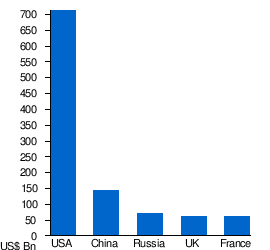
How much the US devoted to military expenditures in 2012 compared to the world's other leading nations. The sum of China, Russia, the UK and France's spending barely exceeds half of what the US alone spends in a year. How much of what we spend is really necessary? 
Photo credit: http://en.wikipedia.org/wiki/List_of_countries_by_military_expenditures

The most interesting aspect of O’Connell’s op-ed however was his critique of the excessive military spending. I assumed that as an officer he would be all for more money and resources. He is not. In fact, he calls for increased skepticism and criticism from Congress. The majority of representatives and senators have no military background, trapping them in a dangerous Catch-22: criticize the military without the proper credentials and be deemed un-patriotic or provide “unhesitating adulation” and allow military spending to balloon out of control. Guess which choice leads to re-election (http://www.nytimes.com/2012/11/05/opinion/the-permanent-militarization-of-america.html?ref=opinion).

The concept of trade-offs in terms of spending often gets lost among political jargon and election ads. When we appropriate funds for one project, another project inevitably loses them. We devote more money to the military, chances are that gets taken from other areas at home. Instead of working to pay off the deficit, we build more tanks. Rather than reduce the cost of a higher education, we establish more bases. Money does not just magically appear; it all comes from somewhere and more importantly, it is a finite amount. Regardless of the outcome of today’s election, I hope our next president will weed out the military budget with the guidance of those who know the industry best. It’s time we bring the troops and the money home.

Increased military spending for the few years after the 9/11 attacks does not come as a surprise. But ten years after the fall of the Twin Towers, why are we still increasing the budget? 
Photo credit: http://en.wikipedia.org/wiki/File:U.S._Defense_Spending_Trends.png 

I don’t approve my tax dollars to do that: free-for-all military spending  

Wednesday, September 12, 2012

I Never Approved My Tax Dollars to do That: Elephant Poaching


Elephant poaching is nothing new to the park rangers of Africa. But what is new is the increased organization, voracity and militarization of elephant poaching in the pursuit of precious ivory. Also new? The decisive role my tax dollars play.

According to a New York Times article from September 4, 2012, tens of thousands of elephants lose their lives each year to poachers who then hack away their tusks and leave the corpse to rot. Officials seized a record-breaking 38.8 tons of ivory in 2011, an amount accumulated at the expense of over 4000 elephants. Though poaching was a “job” previously thought to be reserved for the criminal type, the increasing demand of ivory from China has encouraged more participants to join the lucrative hunt. Ivory has peaked at $1000 per pound in some areas. At that price, and especially when compared to the minuscule salaries soldiers receive, one can understand the irresistible attraction of the ivory trade.

Efficient elephant hunting, however, requires proper weaponry. Proper weaponry costs money. Conveniently, the United States appears happy to help.

During 2011 fiscal year, the United States gave 456.1 million dollars to Uganda, 400.2 million to Sudan and 215.9 million to the Democratic Republic of Congo (http://www.fas.org/sgp/crs/row/RL33591.pdf). Soldiers from all three nations have been caught and reprimanded for elephant poaching (see the above NY Times article).  To Tanzania, another area of active elephant poaching, the United States gave 501.7 million (http://www.fas.org/sgp/crs/row/RL33591.pdf). In addition to funds, the United States also provides some armies, including the Ugandan military, the Congolese Army, and the South Sudan military, with training and assistance (see the above NY Times article).

I don’t dispute the need for foreign aid in many African countries. Poverty and disease are rampant and as a leading world power, we have a responsibility to aid weaker institutions and areas. Yet corruption is also a notorious problem. At the same time, ensuring that financial assistance reaches the rightful recipient is an impossible task, one that no amount of manpower, sanctions, or security could resolve.

My concern lies directly with the funding and training of the military groups that in turn use the US assistance to kill elephants and buy more weaponry from the sales of the ivory. In my opinion, stricter regulation and oversight should accompany further donation of funds. Conviction or acknowledgement of participation in the ivory trade should result in deductions or withholding of aid.

It’s simple: If abused, I want my tax dollars going somewhere else.  Preferably, I want them going away from the elephants.