Showing posts with label romney. Show all posts

Sunday, November 11, 2012

After the Election: Why the Republicans Shouldn't Be So Surprised


The saying goes, “the winner takes it all.” The presidential election is no exception. Romney will be lost to the history books, quickly overtaken by the next GOP hotshot while Obama, his legacy already cemented with his election four years ago, will continue to make an impressive mark. But the election results did more than deny the GOP the position of commander-in-chief. They revealed that Party members are sporting a new accessory: earmuffs.

Yes, earmuffs.

In reading various articles after Election Day, much of the consensus reveals that despite their supposed shock, the Republicans would have seen the writing on the wall had they paid attention. Their reaction to Romney’s fairly decisive loss shows how much the Republicans were completely oblivious to the wants, expectations and actions of American voters. Michael Barone, co-author of The Almanac of American Politics, predicted a 315-electoral vote win for Romney. George Will called 321 for Romney. Karl Rove showed he was no more mature than a five year old, blubbering and throwing a tantrum on Fox News. How could they be so misguided?
 Map of Tuesday's presidential election results in each state. Florida has since officially awarded its electoral votes to Obama. The Republicans claim to be "shellshocked" by the devastating loss but Romney lost by over 100 electoral votes. Even with California, that is no small feat. Of six major  swing states, Ohio, Michigan, Colorado, Florida, Virginia and Iowa, Obama won 5, despite the many claims by Republicans to sweep the swing states. 
Photo credit: http://media2.abc15.com//photo/2012/11/09/electoral_map_cnn_20121109112711_640_480.JPG


I recommend two articles, the first a NY Magazine editorial and a NY Times blog (written by the Times ‘ Editor).

Both articles related that the Republicans’ isolated themselves in their own bubble, discrediting and faulting any source that predicted anything but a landslide win for Romney. By only acknowledging sources and reports that favored them, they tricked themselves into believing a fantasy. What I still don’t understand though is how this could happen on such a national level? The Republican Party is one of two main political parties in the United States. How could they be so out of touch with the 2012 voters?  
In googling images for the map of the electoral college by state, this came up. The author wanted to show the election results if white men, the key Republican demographic, were the only ones allowed to vote.. No surprise that forty-five of the fifty states went red, even die-hard blue California. Thankfully, white men are not the only ones allowed to vote. It's time for the Republicans to acknowledge that.
Photo credit: http://minnesota.publicradio.org/collections/special/columns/news_cut/archive/2012/11/if_only_white_men_could_vote.shtml

One source I read immediately after the election described your typical Republican: white and male. The problem with targeting that particular demographic is that its control on political power is declining with the rise of women and minority voices. The shocking and completely infuriating dismissal of rape by Todd Akin in August, for example, was just one sign of how out of touch the Republican Party is. If he truly felt like he could openly say that and not start a riot (or more importantly lose him the election), then that shows the Republicans have a real problem. Guess what? He lost in Missouri to a Democrat.

It baffles me. Top party leaders are supposed to be astute, savvy and clued into the talk of the nation. We tried to inform them but the Republicans cut their communication lines. It’s not our fault they got handed a defeat. The voters did our job. Now, rather than whine like a group of preschoolers, they ought to re-evaluate who who today’s Republicans ARE. Plural. If the Republicans continue to limit themselves to the rich white man’s club, they’re going to keep losing. Maybe we’ll witness the a rise of new political parties.


Tuesday, November 6, 2012

I Don't Approve My Tax Dollars to do That: Free-for-All Military Spending


In the United States, the first Tuesday in November is probably the most famous day of the month in the United States behind Black Friday and Thanksgiving. That day, which happens to be today, is Election Day. By the end of the night, we [hopefully] will know our leader of the next four years, if voting goes as planned. We shall see if that actually pans out.

Although both presidential candidates have attempted to distinguish themselves over the course of the campaign, portions of their policies line up with one another. One example is that Obama and Romney have both promised to increase the defense budget. As a twenty-year-old with residual resentment about the Iraq War, I’m tired of hearing out expansion of military spending. Problems here at home need urgent attention too, not just those abroad. Imagine my surprise when I read an article posted by my politics professor in which a Marine reserve officer actually agreed with me.

Huh?

In his op-ed column for the New York Times, Aaron B. O’Connell compares our country’s present relationship with the military to that at the end Eisenhower’s presidency. Eisenhower warned of the military becoming too large of an influence in political and domestic affairs, becoming a epicenter around which all other policies would circle, defense-related or not. He pointed out that few of his Naval Academy students remember when America was not at war. I cannot say I recall when a time bombings, death tolls, yellow ribbons and camouflage were not daily contributors on the nightly news. O’Connell claims that service is glorified in the media through television shows and video games. Various military-related demonstrations precede major sporting events. When did we, the civilian population, become so obsessed with our nation’s unequivocal military might?

Particularly popular after 9/11 and the immediate outbreak of the Iraq War, the yellow ribbon, a symbol of supporting the troops and thus being a "good" American, is seen everywhere from trees to cars to businesses. I remember in 5th grade tying yellow ribbons around tree trunks outside of my elementary school in 2003. Now such practice in a public school would bother me. We ten and eleven year olds were not given an option not to support our troops. We just did. In essence we were brainwashed: that the military going to war was a good thing. War is never a good thing. 

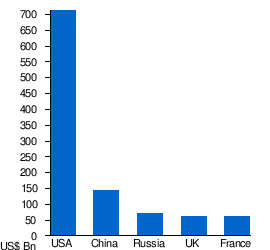
How much the US devoted to military expenditures in 2012 compared to the world's other leading nations. The sum of China, Russia, the UK and France's spending barely exceeds half of what the US alone spends in a year. How much of what we spend is really necessary? 
Photo credit: http://en.wikipedia.org/wiki/List_of_countries_by_military_expenditures

The most interesting aspect of O’Connell’s op-ed however was his critique of the excessive military spending. I assumed that as an officer he would be all for more money and resources. He is not. In fact, he calls for increased skepticism and criticism from Congress. The majority of representatives and senators have no military background, trapping them in a dangerous Catch-22: criticize the military without the proper credentials and be deemed un-patriotic or provide “unhesitating adulation” and allow military spending to balloon out of control. Guess which choice leads to re-election (http://www.nytimes.com/2012/11/05/opinion/the-permanent-militarization-of-america.html?ref=opinion).

The concept of trade-offs in terms of spending often gets lost among political jargon and election ads. When we appropriate funds for one project, another project inevitably loses them. We devote more money to the military, chances are that gets taken from other areas at home. Instead of working to pay off the deficit, we build more tanks. Rather than reduce the cost of a higher education, we establish more bases. Money does not just magically appear; it all comes from somewhere and more importantly, it is a finite amount. Regardless of the outcome of today’s election, I hope our next president will weed out the military budget with the guidance of those who know the industry best. It’s time we bring the troops and the money home.

Increased military spending for the few years after the 9/11 attacks does not come as a surprise. But ten years after the fall of the Twin Towers, why are we still increasing the budget? 
Photo credit: http://en.wikipedia.org/wiki/File:U.S._Defense_Spending_Trends.png 

I don’t approve my tax dollars to do that: free-for-all military spending  

Wednesday, October 31, 2012

I Approve My Tax Dollars to do That: Provide Natural Disaster Relief


I know most of my recent posts have related to things I approve or need my tax dollars to do. Although I originally planned to write this post about an expenditure I do not approve of, I was so appalled by what I read in this NY Times editorial that I needed to share it.

When a natural disaster like Hurricane Sandy strikes the United States, a federal body called the National Response Coordination Center heads recovery efforts. The umbrella organization of the Federal Emergency Management Agency (FEMA), the Coordination Center decides how to allocate and distribute various forms of aid. It also assists with any evacuations. As a federal body, it has vast resources and authority at its disposal. Furthermore if states are already distressed or without means of communication during or after a storm, it is one fewer things the state has to deal with. The state is already in enough trouble; it should not have to orchestrate aid efforts as well.

Flooding of the subway system has brought New York City to a standstill: schools are closed, Wall Street vacant, hospitals evacuated and people trapped in upper-story apartments without power. Under Romney's plan, how is a state capital under water supposed to coordinate an effective emergency response without power and transportation? 
Photo credit: http://inhabitat.com/nyc-public-transit-system-crippled-after-hurricane-sandy-causes-widespread-flooding/ 

Romney, however, wants to eradicate the National Response Coordination Center and shift emergency management not even to the states but to the private sector. Consequently “profit-making companies,” rather than the federal government, would control the emergency response. Because it makes a lot of sense to have people’s safety, evacuation and aid be in the hands of businesses out to make a buck. Who’ll get the bottles of water, blankets and protein bars? Those who can pay for it.

Yes, because Massachusetts expect to experience hurricane-strength storm surges and thus it's our fault the coastline got slammed. (Winthrop, MA)
Photo credit: http://www.nydailynews.com/news/hurricane-sandy-strikes-east-coast-gallery-1.1194577 

The author, whose name was nowhere to be found on the editorial itself, explained why Republicans despite nationally-overseen emergency management: “Many don’t like the idea of free aid for poor people or they think people should pay for their bad decisions, which this week includes living on the East Coast.”

Excuse me!?  

Hurricane Katrina crippled Louisiana. The West confronted massive wild fires all last summer and into the fall. Tornadoes rip through the Midwest. Earthquakes vex the West Coast. Blizzards shut down much of the North. Every part of the country experiences some form of natural disaster; there is no “safe” state. A natural disaster is no one particular person’s fault. Yet when their states get affected, they come crying for federal aid and financial assistance. How totally hypocritical. You don’t want federal aid? Fine, then don’t take it. See how effective the response is. Like health care, emergency management is not something that belongs in the private sector. It belongs to the federal government.

Even the city that never sleeps is no match for a hurricane. 
Photo credit: http://www.theatlantic.com/infocus/2012/10/hurricane-sandy-after-landfall/100396/

I approve my tax dollars to do that: fund FEMA and the National Response Coordination Center.


Tuesday, October 2, 2012

Romney and My Tax Dollars


Opening Safari this morning, I noticed that my homepage, nytimes.com, displayed an intriguing headline: "The Mitt Romney Who Might Have Been"

Huh?

He’s the Republican presidential candidate and a former governor. He is already a very well known and publicized figure. As such, most if not all Americans around or above voting age know his name. What else could he have been? Curious, I shoved my current homework aside, clicked on the link and began to read.

In a two-second summary of the article, author Robert Draper evaluated Romney’s role as an informal McCain advisor during the 2008 race and his performance as Massachusetts governor. The point? Romney aimed to please.

I highly recommend reading it if you wish to see a preview of President Romney. 

Rather than remain steadfast to his promises or convictions, Romney preferred to go along and do what would win him support and favor. A perfect example of this is his revelation about Roe vs. Wade. Once the potential of a presidential campaign emerged mid-way through his term as governor, his position on a woman’s right to choose reversed from support to opposition. His loyalty never lay with Massachusetts. One of his environmental officials told the Times, “Clearly, in retrospect, he was weighing what was right for Massachusetts with how it would play nationally." (nytimes.com) 

Melanie's Law, a law targeted at getting more drunk drivers caught repeatedly off the road, is seen as one of the big success stories of Romney's term as Massachusetts governor. While it has been successful at getting repeat offenders off the road, seeing as it was introduced as a result of the tragic death of a young girl by a repeat offender drunk driver, there was little political resistance to its enactment. IID stands for ignition interlock device: you must blow into it and pass or else the car will not start. 
photo credit: http://www.mass.gov/rmv/rmvnews/2008/iid_removals.gif

Now imagine a president weighting what was right for the United States with how it would play on the international stage. Not good. 

I do acknowledge that the Times tends to lean toward the left and therefore this evaluation of Romney is somewhat biased. However, as a Massachusetts resident, much of its criticisms about his performance ring true. Who wants a governor who spends the last two years of his term away forwarding his own presidential campaign? Should he get elected, will he spend the latter years of his term focused on his re-election campaign instead of our nation’s current crises? I want my president here and actively engaged in the needs of the United States. I want him to take a decisive stand on issues and not allow his hopes for re-election to taint his decisions. He must preside in the present: not in the prospects of the 2016 race.

Funny how he approved a similar health care system in Massachusetts that took effect while he was governor that is viewed as one of his other big successes and he now rejects such a system on a nation-wide scale. You no longer hear Bostonians complaining about the state-wide health insurance requirement. Massachusetts also has some of the best health statistics in the nation. 
Photo credit: http://s.wsj.net/public/resources/images/OB-TO311_0628sc_G_20120628120827.jpg

Obviously the 2012 presidential election is a huge determinant in the future of my tax dollars over the course of the next four years. I make no secret about the fact that I am a liberal: I favor big government, I support a woman’s right to choose and I applaud universal health care. But in some ways, I view myself as a fiscal conservative. I dislike when my hard-earned tax dollars are wastefully and ineffectively spent. I especially grapple with the concept of welfare systems. My philosophy is simple: live within your means. If you fail to do so, then that is your financial problem, not mine and certainly not my tax dollars’.

That being said, obviously I will not vote for Romney.  But in addition to our ideological differences, I do not trust him to be responsible with my tax dollars because he flip-flopped so many times on issues and policies as governor. If elected president, which Romney are we actually going to get?


Saturday, September 8, 2012

At The Trailhead


Two months out from the November presidential election, it seems as though all anyone can talk about is the campaign. Engaged in a transcontinental game of “he said, she said,” both Obama and Romney pledge reforms neither can realistically make while they simultaneously denounce their opponent and his party. Scanning the headlines on NYTimes.com yesterday, I saw election coverage, election coverage and what a surprise more election coverage. Thus I wanted to take this opportunity to remind Mr. Obama and Mr. Romney (as well as the American media) that there is more going on in September 2012 than who will next inhabit the White House. 

Exasperated, I clicked on the “World” tab and browsed the article titles, finally settling on one that fell under the “Most E-mailed” category. The five-page article, Elephants Dying in Epic Frenzy as Ivory Fuels Wars and Profits, revealed the disturbing escalation of violent elephant poaching as a result of increased demand for ivory in Asia. I’ll expand upon my thoughts about the article in the next post but in the meantime, check out the full article here. Most upsetting to me however wasn’t the loss of elephant life: it was the fact I’d indirectly facilitated it.  More specifically, it was my tax dollars designated to support underfunded ally African governments that enabled the deaths of hundreds and hundreds of elephants for their precious tusks.

That’s funny…I never approved my dollars to do that.

            This November, I will join the many previously ineligible voices in casting my first vote in a presidential election. With Election Day rapidly approaching, it is our responsibility to be educated voters.  As part of an assignment for my World Politics class at Mount Holyoke College, I’m making it my mission to investigate and track down my federal tax dollars on all seven continents. Where exactly do they go? Who benefits from them? Do people actually benefit from them? Are the recipients really deserving of aid? And most importantly, where do I want them to go?
 photo credit: http://www.jessehora.com/index.php?/ongoing/somethin-somethin-series/