In the United States, the first Tuesday in November is
probably the most famous day of the month in the United States behind Black
Friday and Thanksgiving. That day, which happens to be today, is Election Day.
By the end of the night, we [hopefully] will know our leader of the next four
years, if voting goes as planned. We shall see if that actually pans out.
Although both presidential candidates have attempted to
distinguish themselves over the course of the campaign, portions of their
policies line up with one another. One example is that Obama and Romney have
both promised to increase the defense budget. As a twenty-year-old with
residual resentment about the Iraq War, I’m tired of hearing out expansion of
military spending. Problems here at home need urgent attention too, not just
those abroad. Imagine my surprise when I read an article posted by my politics
professor in which a Marine reserve officer actually agreed with me.
Huh?
In his op-ed
column for the New York Times, Aaron B. O’Connell compares our country’s
present relationship with the military to that at the end Eisenhower’s
presidency. Eisenhower warned of the military becoming too large of an
influence in political and domestic affairs, becoming a epicenter around which
all other policies would circle, defense-related or not. He pointed out that
few of his Naval Academy students remember when America was not at war. I
cannot say I recall when a time bombings, death tolls, yellow ribbons and
camouflage were not daily contributors on the nightly news. O’Connell claims
that service is glorified in the media through television shows and video
games. Various military-related demonstrations precede major sporting events.
When did we, the civilian population, become so obsessed with our nation’s
unequivocal military might?

Particularly popular after 9/11 and the immediate outbreak of the Iraq War, the yellow ribbon, a symbol of supporting the troops and thus being a "good" American, is seen everywhere from trees to cars to businesses. I remember in 5th grade tying yellow ribbons around tree trunks outside of my elementary school in 2003. Now such practice in a public school would bother me. We ten and eleven year olds were not given an option not to support our troops. We just did. In essence we were brainwashed: that the military going to war was a good thing. War is never a good thing.
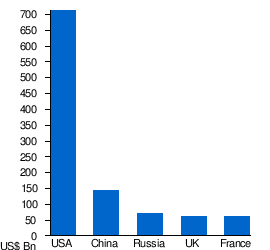
How much the US devoted to military expenditures in 2012 compared to the world's other leading nations. The sum of China, Russia, the UK and France's spending barely exceeds half of what the US alone spends in a year. How much of what we spend is really necessary?
Photo credit: http://en.wikipedia.org/wiki/List_of_countries_by_military_expenditures
The most interesting aspect of O’Connell’s op-ed however was
his critique of the excessive military spending. I assumed that as an officer
he would be all for more money and resources. He is not. In fact, he calls for
increased skepticism and criticism from Congress. The majority of
representatives and senators have no military background, trapping them in a
dangerous Catch-22: criticize the military without the proper credentials and
be deemed un-patriotic or provide “unhesitating adulation” and allow military
spending to balloon out of control. Guess which choice leads to re-election (http://www.nytimes.com/2012/11/05/opinion/the-permanent-militarization-of-america.html?ref=opinion).
The concept of trade-offs in terms of spending often gets lost
among political jargon and election ads. When we appropriate funds for one
project, another project inevitably loses them. We devote more money to the military,
chances are that gets taken from other areas at home. Instead of working to pay
off the deficit, we build more tanks. Rather than reduce the cost of a higher
education, we establish more bases. Money does not just magically appear; it
all comes from somewhere and more importantly, it is a finite amount.
Regardless of the outcome of today’s election, I hope our next president will weed
out the military budget with the guidance of those who know the industry best. It’s
time we bring the troops and the money home.

Increased military spending for the few years after the 9/11 attacks does not come as a surprise. But ten years after the fall of the Twin Towers, why are we still increasing the budget?
Photo credit: http://en.wikipedia.org/wiki/File:U.S._Defense_Spending_Trends.png
I don’t approve my tax dollars to do that: free-for-all
military spending


