Showing posts with label Affordable Health Care Act. Show all posts

Sunday, October 28, 2012

I Approve My Tax Dollars to do that: Bring Back Tetracycline


Attending a conference on small animal dermatology yesterday, one of the veterinarians asked the speaker about what drug to use as a substitute for one that is currently unavailable. To my surprise, the unavailable drug was not some obscure, esoteric medication. It was tetracycline, one of the most common broad-spectrum antibiotics used in human and animal medicine. I was shocked. How can such a drug be unavailable?

The current drug shortage is not a new problem. Since 2007, the number of unavailable drugs has been on the rise, peaking at over 280 as of October 2012. It is unclear as to when the shortage will be resolved. 
Photo credit: http://online.wsj.com/article/SB10001424052748704680604576110613604195324.html

Tetracycline joins the list of over two hundred drugs currently unavailable; a crisis over two years in the making. The entire list of unavailable medications can be accessed here. For the most part, the drugs on the list aren’t your unusual, random, rarely prescribed medications: they are your cancer treatment drugs, nutritional aids, anesthesia drugs, and antibiotics (http://onpoint.wbur.org/2011/10/04/prescription-drugs). The FDA cites manufacturing and quality issues as the main cause of the shortage. These include regulatory violations such as incorrectly printed expiration dates on bottles and sterility issues during production, and shortage of raw materials required to make the drugs. Though companies are required to inform the FDA of an imminent shortage and the estimated duration of the shortage as part of the Food and Drug Safety and Innovation Act passed in July, the FDA cannot force them or other companies to manufacture the drug. (http://www.fda.gov/Drugs/DrugSafety/DrugShortages/ucm050796.htm). The shortage affects a large number of suppliers but the majority of the drugs on the list only have one or two sources of supply (http://www.imshealth.com/portal/site/ims/menuitem.edb2b81823f67dab41d84b903208c22a/?vgnextoid=a6fbcc0f68f73310VgnVCM100000ed152ca2RCRD&vgnextfmt=default&vgnextrefresh=1)

How drug shortages affect patient care. While some drugs can be replaced with near equally-effective substitutes, such as doxycycline for tetracycline, others cannot. Even in the case of replacing tetracycline with doxycycline, increased use of one antibiotic risks creating increased resistance to that particular antibiotic. The last thing we need to do is to create more antibiotic-resistance super bugs such as Merca. 
Photo credit: http://online.wsj.com/article/SB10001424052702304584404576442211187884744.html 

Despite what the FDA claims, the shortage stems from more than manufacturing and quality assurance problems. Like most other shortages, the current drug shortage has as much to do with business as production. As more drugs became available in cheaper generic versions, companies quit producing brand-name versions because they could not earn a profit turning out more expensive drugs that neither hospitals nor insurance companies would pay for. They then switched to the less readily prescribed drugs. The switch ensured protection of their business venture, as financially it made no sense for generic companies to take up production for smaller quantities. Shortages arise when the generic companies producing the drugs experience material shortages or are shut down by the FDA for production violations. No factories, no drugs  (http://www.thelancet.com/journals/lancet/article/PIIS0140-6736(12)60414-0/fulltext).

Health care should not follow free-market policies, especially not when people’s lives are at stake (I refer specifically to the availability of cancer drugs). What my body needs should not be at the mercy of companies more interested in making a dollar than my health. It’s absolutely ridiculous to me that such basic drugs are inaccessible to the public. Congress should exercise increased authority over drug manufacturers, holding them to tougher, and more stringent and ethical standards. At least fifteen deaths have been reported as a direct result of the shortage (http://www.thelancet.com/journals/lancet/article/PIIS0140-6736(12)60414-0/fulltext). Congress needs to do something. Medicine is not about money: it’s about getting better.

I approve my tax dollars to do that: bring back my tetracycline. 

Some of the more popular drugs currently unavailable and their uses. Uses range from nutritional supplements, such as electrolytes, to cancer treatments. How would you feel if you went to the hospital and were told you couldn't be treated because the drug was not available? This is why we need to improve and increase federal overnight of drug manufacturing. 
Photo credit: http://sfmedicalsociety.wordpress.com/2011/08/22/prescription-drug-shortages-forcing-physicians-and-pharmacists-to-scramble/


Sunday, September 30, 2012

Can an Iranian System Really Help Mississippi?


Back to the question from my previous post: Can HealthConnect, an agency based on the primary health care system established in post-revolutionary Iran, really help Mississippi?


According to HealthConnect’s founder Dr. Aaron Shirely, HealthConnect serves two purposes in Mississippi: improve primary care for its rural residents and prove that Medcaid and health insurance will not eradicate all of the state’s health problems.


One of the major problems in Mississippi is the routine use of the emergency room for primary care. Patients who arrive in the ER and cannot afford treatment are still treated at taxpayer expense. While such practice is unfair to taxpayers, cutting of taxes appropriated toward this purpose will not prevent the arrival of unpaying patients to the ER. About 550,000 out of three million Mississippi residents lack health insurance. The state only has 176 doctors per 100,000, the lowest ratio in the country. Those numbers piggyback on Mississippi’s rank as “the country’s poorest and most racially divided state.”  That is where HealthConnect fits in. 

Mississippi is not the only state with a high percentage of its population lacking health insurance. This graph shows how it compares to nearby states and to the proportion of uninsured in the country as a whole. Note: these percentages reflect 2012 numbers. 
Photo credit: http://mepconline.com/blog/healthcare/building-toward-economic-mobility-in-mississippi-health-care/

This map shows the population density and the location/size of hospitals. Clearly there are fewer and smaller hospitals compared to the number and size in urban areas. No wonder such a large proportion of the population goes untreated simply because they do not have easy access to health care. 
Photo credit: http://archive.ahrq.gov/prep/nursinghomes/atlas/atlas_ms.gif

Unlike emergency C-sections, quadruple bypasses and ventilators, HealthConnect does not go after the final stage eruption of a health problem; it combats the part of the cause. While home-health agencies will dispatch nurses to conduct work in the patients’ homes, their care requires insurance and they often work for unregulated, lucrative for-profit agencies. Shirley’s approach, on the other hand, argues that the health care provider must be in it solely for the benefit of the patient. Without that sense of responsibility and loyally, the profit, rather than the best interests of the patient, is the foundation of treatment options.

Furthermore, the caregiver “must come from the patients world.” Black patients often do not trust white caregivers and will fabricate answers to pacify nurses or prevent them from asking more questions. As the daughter of a health care provider, one of the most important aspects of proper diagnosis and treatment is honesty with your doctor about symptoms, conditions and what you are experiencing. If a doctor does not know what is wrong, how can she or he effectively treat a patient?

Clearly, poverty in Mississippi is still very much a racial issue. As a result, it is imperative that an adequate proportion of Mississippi health care providers are African American who can actually see which health care problems stem from racism and mistrust on both sides. 
Photo credit: http://mepconline.com/blog/wp-content/uploads/2012/06/Child-Poverty-Rate-by-Race-Mississippi.jpg

Part of Shirley’s goal is to “get into homes and alter the course of future generations before obesity…or diabetes sets in.” He wants to make it so that the patients will trust their health care providers and in turn take measures to improve their health. To achieve this goal, Shirley opened health care houses in the schools. The location gave him access to both growing kids, to whom he can provide the most long-term benefit by teaching them good health practices early on, and their families. He also fills a much-needed gap, as many Mississippi public schools lack full-time nurses.

The workers of HealthConnect do not work 9-5. They are always trying to help, whether it take the form of allowing people who do not have electricity to stay a night in their home, making an unscheduled stop to check up on a patient and her new baby, or extending an appointment by an extra fifteen minutes to admire the patient’s family photos on the wall. In a way, they fulfill a particular void in many poor Mississippians’ lives: they act as family.

Many people shy away from making this kind of commitment. You sacrifice much of your time, energy and life to taking care of other people at a much higher cost than simply the financial expense. I am reminded of this every time I come home from college and my mom has to go do an emergency within five minutes of my arrival. But in the case of the poverty-stricken Mississippi Delta where all other attempts to improve health care have failed, such commitment is imperative. And I believe that it will work. Only proactive prevention of the most common killers of Mississippi residents, HIV/AIDS, diabetes, congestive heart failure, hypertension and asthma, will stop them from appearing in the ER when it is too late to treat them.

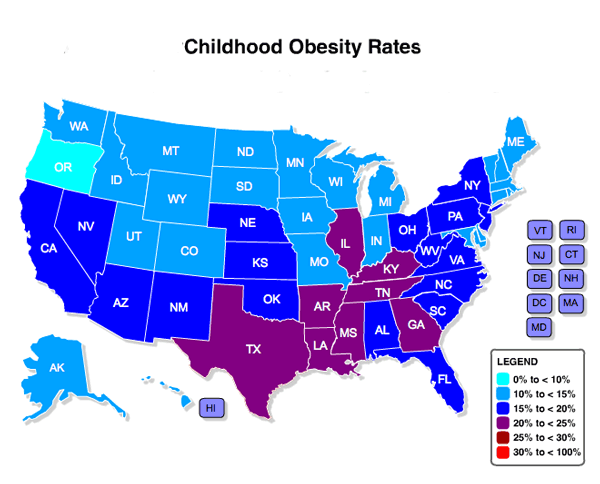
Obesity is one of the many faces of poverty in the United States. Left unaddressed, it condemns the child to an early death before he or she even becomes a teenager. As the cause of other conditions, Type II diabetes and high blood pressure for example, it proves to be more expensive to treat later than to prevent with a healthy diet and exercise now. Basic exercise (walking, running, push ups, crunches, etc) is free. Emergency room care is not. 
Photo credit: http://www.nourishinteractive.com/system/assets/general/images/nutrition-facts/childhood-obesity-rates-US-2011.gif 

I was appalled to read that some Mississippians have to shop for food at a gas station because a fully stocked grocery store is thirty miles away. That should not be the case in the twenty-first century United States. Insurance or Medicaid will not change that. But agencies like HealthConnect, who promote the well being of the patient and go after things like availability of healthy food and accessibility of medication, can.


Wednesday, September 26, 2012

Should I Approve My Tax Dollars to do That: Learn from Iran


In 2001, my mom described her health care philosophy to the Boston Globe: "Medical care is ideally broad enough to envelop not only the technical part of treating an illness, but caring for the whole animal - and the family around it.”


Though my mom’s expertise pertains primarily to animals, Dr. Aaron Shirley shares a similar sentiment about human patients. In 2010, Shirley founded HealthConnect, a rural Mississippi medical provider that provides a “holistic, intensely personal approach” to patient care. His inspiration for HealthConnect stems from “an unlikely place:” Iran.

In the 1980s, the Islamic Republic of Iran implemented a new primary health care system to combat the unsettling differences in health care quality and availability of rural and urban areas. As a result of this disparity, urban populations that had better access to better health care tended to out-health their rural counterparts.

The system was based on a single, multitiered structure. The first level, “health houses,” were constructed to accommodate the primary health care of approximately 1,500 people all of whom lived within an hour’s walk or less.  The 1000-square-foot houses themselves consist of exam rooms, sleeping quarters, and staff, who men and women trained in basic, preventative care. Services included family planning, prenatal care, nutritional advice, and immunizations.

The next tier was the rural center followed by the district hospital. This way, those who become very sick or require surgery, had access to a better-equipped hospital. It was also relatively inexpensive to implement. (http://www.nytimes.com/2012/07/29/magazine/what-can-mississippis-health-care-system-learn-from-iran.html?pagewanted=1&_r=4&hp).


Here you can see the flow of the hierarchical Iranian system and comparison of that flow between rural and urban centers. By the third tier, the urban and rural areas share the same hospitals. 
Photo credit: http://www.emeraldinsight.com/content_images/fig/0730190502001.png 

I see two crucial and extremely effective features of Iran’s system. The first is that by establishing good primary care, a more serious condition can be caught early before it lands the patient in the (expensive) emergency room or worse, dead. Obviously not all conditions are preventative. But many that face people living in poverty, such as diabetes, malnutrition, water contamination, malaria and other mosquito-transmitted diseases, and to an extent HIV, can be addressed before they reach a point of no return.

The second is that the health care workers are not foreigners imported in their fancy white lab coats and fancy stethoscopes; they are natives. They grew up in the villages they serve. They can relate to their patients on a personal level because they already share common ground, helping to forge an imperative sense of trust between health care provider and recipient. Such familiarity allows them to truly understand the problems their patients face and know certain realities of a solution. Some treatments we consider to be relatively elementary are impossible to prescribe in rural areas. Anything needing to be stored in the fridge, for example, is off the table for isolated areas without electricity.

In explaining how he made the leap from Iran to the United States, Dr. Shirley told the New York Times, “The Iranian model eliminated the geographic disparities, so why couldn’t this same approach be used for racial and geographic disparities in the United States?”

By establishing HealthConnect in rural Mississippi, the state with some of the worst health statistics in the country, Dr. Shirley is putting his money where his mouth is.
(http://www.nytimes.com/2012/07/29/magazine/what-can-mississippis-health-care-system-learn-from-iran.html?pagewanted=1&_r=4&hp).
Photo credit: http://faithandhealthdotorg.files.wordpress.com/2012/07/screen-shot-2012-07-31-at-8-43-53-am.png


The question now is, can HealthConnect actually help Mississippi?


Monday, September 24, 2012

I Approve My Tax Dollars to do That: Re-Vamp Health Care


The Obama Administration has pointed to and praised the Affordable Health Care Act as the way to fix our nation's broken health care system. But what if the solution actually involves the opposite? What if the disintegration of structured hierarchical medicine and insurance will increase the availabilty and quality of health care? 


I'm referring to the re-establishment of the house call practice.

Most Americans have never interacted with a family doctor who comes to their home and oversees their primary health care. Here there are no cold exam tables, no waiting rooms, and no stark white lab coats. I would not be familiar with such a concept either had I not grown up tagging along with my mom on appointments as she juggled her black doctor's bag in one hand and a rambunctious 2-week-old me in the other. 

With the back of her Toyota 4-runner loaded up with vaccines, records and other supplies, she drives from appointment to appointment rather than insisting her clients come to her. She has approximately 200 patients. Her paperwork office is in our house. She adjusts her prices based on a client's income so that the patient still receives adequate care. She knows every client by name and face. My mom leaves her cell phone number on the answering machine so that if one of her patients has an emergency, the client can easily get ahold of her. When we go on vacation, she always leaves that number as well. Though it is frustrating to get interrupted on holidays or vacations, she argues she took an oath; and she intends to uphold it. 

Some of her freedom stems from the fact she's a veterinarian as opposed to a doctor. But during my last visit home, an elderly client called, saying she had fallen and her hip hurt. My mom takes care of her cats. Despite having had knee replacement surgery a five weeks earlier, she and I drove over to this client's house to evaluate and comfort her. We ended up calling 911 and waiting with her until the ambulance arrived. Once home again, she attempted to contact the woman's family in Arizona. She even made arrangement for the care of the woman's cats. Talking to her about it later, I asked why she went over instead of just calling 911 from our house. She said, "You really get to know someone when you see them in the context of their real life. You can't do that in an office." 


An example of how house call vets interact with both their clients and their patients. Note the oven in the background. Both dog and vet are sitting on the floor. Neither look stressed or upset. 
Photo credit: http://www.yourathomevet.com/html/aboutus.html 

My mom understands where her clients are coming from and how they feel toward their animals. She can relate to them as a parent. She knows them on such a more personal level because of how she conducts her practice. Since her patients are less stressed without the hassle of transport to a clinic, her practice benefits the animals too. While there is a travel fee, her services are affordable. Whenever a problem arises that she cannot accommodate, she refers her clients to local hospitals. In a 2001 interview with the Boston Globe, she said, "I'm a primary-care doctor. I do the things I can do well; when it's something that's better taken care of at a hospital, I refer people." (ttp://pqasb.pqarchiver.com/boston-sub/access/70460160.html?FMT=FT&FMTS=ABS:FT&type=current&date=Apr+1%2C+2001&author=Naomi+R.+Kooker%2C+)

One client told me, "It's so comforting to know that when I have a problem, I don't have to wait for a call back or speak with a grouchy receptionist. I can speak directly with my dog's veterinarian. If he has a problem that requires more than she can do, she tells me and I take him into a clinic. But then when I know it's time, she'll be there to put him down in my own home. What pet owner doesn't want that?" 

Many of our problems in human medicine would benefit from implementing house call or house-call like practices. The key characteristic is being able to engage with your patients on a personal enough level that you can help them develop the best health care plan. Patients have to trust you, and feel like you understand them. Without that trust, the doctor-patient relationship is doomed and ultimately the patient suffers. 

In my next blog post, I will discuss a experimental system taking hold in the United States is trying to improve care in rural areas by integrating a house call approach with more advanced care. Who ever thought Mississippi would have something to learn from Iran? 


Monday, September 17, 2012

Should I Approve My Tax Dollars to do That: Import Health Care


While most career fields in the United States experienced job loss during the recession, the health care sector added 1.2 million jobs, a lone “bright spot in the economy”. Yet an NY Times Op-Ed Column alerted me to a disheartening reality. To fill the demand for new health care professionals, we are not educating and employing our own. Instead, we are importing them.

The demand for more health care workers arose in part from changes imposed by Obama’s Affordable Health Care Act and the aging of the Baby Boomers.  However, American medical schools have not responded with an increased output of M.D.s. They still reject hundreds of thousands of qualified applicants while we fill the need for doctors by importing foreigners who now comprise twelve percent of the health work force. In 2011-2012, 43,919 students applied to US medical schools. While that number does not differentiate between domestic and international students,  only 19,230 students actually matriculated (https://www.aamc.org/download/153708/data/charts1982to2012.pdf). The author of the Times article, Kate Tulenko, argues that in doing so, we are also taking doctors away from the areas that really need them. Countries where twenty percent of children die before their first birthday should not be losing health care workers to the United States. Leave those doctors to do a job that for many is a matter of life and death and start increasing the production of our own.

As someone pursuing a career in medicine, the ability to get into (and consequently pay for) school is a big concern. Though I plan to enter veterinary school, applicants across pre-health fields face the same dilemmas of completing mile-long lists of requirements, achieving impossibly high test scores and GPAs in order to be competitive and extraordinary volunteer work, extracurricular activities, internships or research so yours stands out among the myriad of applications. Such glitter, if you will, often requires two things: money and connections.
 Politics and financial status should be irrelevant when it comes to health care. Good health care entails a patient and his/her doctor devising preventative, maintenance and recovery plans that best suit the patients needs. Yet a paper application ignores that necessary quality. For example, it is pointless to prescribe insulin to a diabetic patient in rural Mississippi if she does not own a fridge to store it in. The doctor must figure out a more creative, unorthodox approach. She (the patient) frankly will not know or care if her doctor had a 4.0 GPA as an undergraduate or achieved a perfect score on the MCAT. She will just want to feel better.


I wholeheartedly support the exchange of techniques, theories, and developments across nation lines. But I have a real problem with the fact that the US has imported and is importing tens of thousands of health care workers while there are thousands more already here ready to take the Hippocratic oath. The Federal Government needs to apply more pressure on medical schools and state regulators to increase the number of teaching hospitals, increase class size and reduce the cost of a health profession education. Everyone has the right to adequate health care. But first, they need access to the people. Thus even before we facilitate the access, we need the people.

So in asking myself whether I approve my tax dollars to import health care, my answer is no. I want more of my tax dollars devoted to encouraging the education and output of American health care workers.

Think about it: what do you want from your doctor?