Showing posts with label eco-friendly. Show all posts

Tuesday, October 16, 2012

I Approve My Tax Dollars to do That: Tax Plastic Bags


In my previous post, I proposed that the United States tax plastic bags.

Such a tax has been extremely successful in Ireland. Currently, the tax is set at thirty-cents (in US dollars) per bag.  All of the money procured from the tax goes directly to the environmental ministry for enforcement and clean-up projects. Shopkeepers initially thought consumers would not accept it, fearing for the well being of their businesses.

At this point however, ten years after the tax was introduced, the tax is no longer really about the money. It has become “socially unacceptable” to carry plastic bags, addressing a “very bad habit” that people can easily change by investing in reusable bags. People are actually enthusiastic about it and proud of what Ireland has done to eradicate plastic bags. (http://www.nytimes.com/2008/01/31/world/europe/31iht-bags.4.9650382.html?pagewanted=all&_r=0)

Since it was introduced ten years ago, the tax has generated 166 million euro for Ireland. (http://www.irishexaminer.com/ireland/plastic-bag-levy-nets-166m-in-10-years-185605.html)
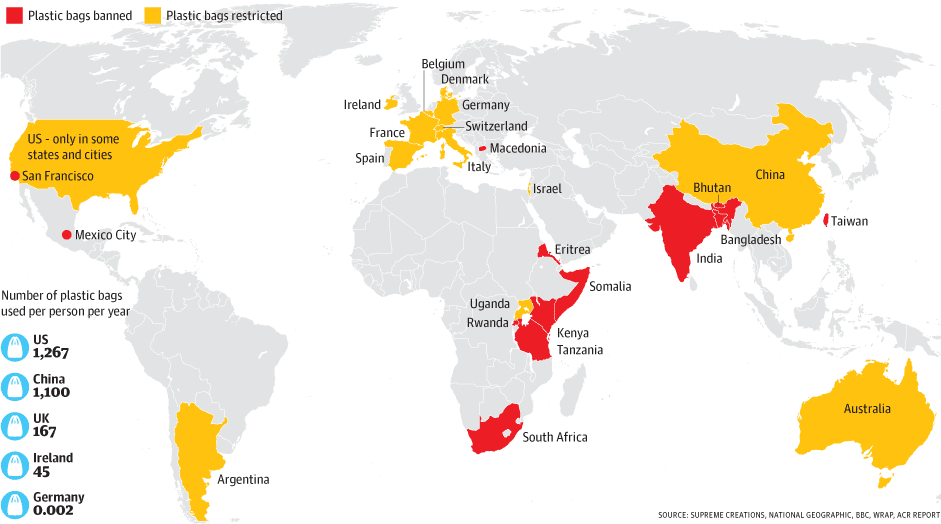

 As the map illustrates, very few parts of the world have enacted taxes or bans on plastic bags. In the US, each person uses 1267 plastic bags per year. Compare that number to Germany, which has one of the longest standing taxes on plastic bags, clocks in at less than a single plastic bag per person per YEAR. Time for the United States to step up its game. 
Photo credit: http://static.guim.co.uk/sys-images/Guardian/Pix/maps_and_graphs/2009/07/15/Plastic_bags940.gif

Individual US cities have taken similar measures to ban plastic bags. Washington DC now charges five cents for every disposable grocery bag. (http://content.usatoday.com/communities/greenhouse/post/2010/10/us-cities-ban-plastic-bags/1#.UH4AhI4ZdSo) During its first year in effect, DC collected an additional $2 million in tax revenue. (http://www.huffingtonpost.com/2011/12/01/plastic-bag-bans-fees_n_1123439.html) Imagine having such an effect on a national level. If one of America’s cities generated that much additional revenue, how much would expanding the tax to ten other big cities generate?

Seattle made the switch, banning plastic shopping bags entirely rather than taxing them. Paper bags, however, are taxed, addressing another environmental concern. Paper bags are often viewed as a more eco-friendly alternative to plastic when in reality, they are just as bad for the environment with the amount of water and the number of trees used to produce them.
Photo credit: http://westseattleblog.com/blog/wp-content/uploads/2012/06/bagbanflyer.jpg

One alternative proposed by plastic manufacturer retailers is to promote recycling of the bags by installing recycling centers in stores. (http://content.usatoday.com/communities/greenhouse/post/2010/10/us-cities-ban-plastic-bags/1#.UH4AhI4ZdSo)

In all seriousness, how many of us actually recycle our plastic bags?

My hometown transfer station recycles every type of plastic…except bags.

The switch is not a hard one. But most will only do it if forced to with a tax. Hey, in my opinion, it’s not money out my pocket. I already made the switch. 

I approve my tax dollars to do that: tax plastic bags. 

Thursday, October 11, 2012

I Approve My Tax Dollars to do That: Discourage the Use of Plastic Bags


We all know money does not grow on trees. But what if it did “grow” in nearly every town and city yet no one bothered to “harvest” it? Once having realized the existence of a vast pool of wasted potential dollars, would you not want to put them to work?

I would.

Nearly every store, from Walmart to Stop n Shop to Walgreens, provides its customers with disposable plastic bags. Very few of these bags do more than shuttle a buyer’s goods from the store to his or her home. For the average American family, this equates to nearly 1500 bags (www.nrdc.org/media/2008/080109.asp). Less than 5 percent of these bags are recycled (Evironmental Protection Agency), while the remaining 95 percent, or 100 billion bags, get thrown away (www.worldwatch.org/node/5565).

This is why I propose a tax on plastic bags.

Since 1977, everyone who has ever stood in a checkout line has heard the phrase, "paper or plastic?" Now there's a popular third alternative: your own. You can use canvas totes, nylon bags, bags that come as free "thank you for sponsoring us!" presents, or really anything that has sides, a bottom, and two handles. It is one of the quickest easies ways to go green. 
Photo credit: http://notstepfordwives.com/wp-content/uploads/2010/02/canvas-grocery-bag.jpg

The concept of “paying for plastic” first revealed itself when I was 10. My parents and I were on vacation in Ireland and were charged extra at a store for packing our groceries in plastic instead of supplying our own bags. This was 2002. Several years later I bought and began to bring my own reusable bags to my grocery store at home. The practice became increasingly popular at my local Shaw’s. I soon realized I could use my reusable totes for more than my milk, bread and cheese. Several bags live in the back seat of my car so that when I make an impromptu CVS run, for example, I do not have an excuse not to use one of my eco-friendly bags. Yet when I made my annual back to school Walmart trip this fall (I tend to avoid shopping at Walmart when possible), the cashier seemed shocked that I was asking her to please pack my items in my cloth bags. Glancing at the other checkout lanes, I was the only customer who had brought her own reusable totes. That shocked me.

Ireland is not the only area to institute sanctions on plastic bags. However, Ikea's additional charges for both types of bags somewhat defeat the purpose. If people forget their bags (or do not use them), they will pay $.05 a bag for a plastic bag compared to $0.59. Furthermore, considering Ikea sells primarily furniture, I cannot imagine that they use nearly as many bags as Walmart, CVS, Walgreens, Target, etc.
Photo credit: http://www.watershedmedia.org/images/actionStatistics.gif 

One cloth bag will replace 1000 plastic bags (http://www.green-kits.com/paperorplastic.html). Grocery and big chain stores near me sell them for between $0.99 and $1.29 each. Some may argue that why pay for cloth when you get plastic for free. Plastic is actually relatively expensive, both in its production and disposal costs. At least 12 million barrels of oil per year are devoted to the production of plastic grocery bags (The Wall Street Journal). With so much oil used in their production, fourteen plastic bags could fuel a passenger car for one mile (www.sprep.org/factsheets/pdfs/plasticbags.pdf). Plastic bags are expensive on the environment too, taking up to 1000 years to break down (www.worldwatch.org/node/5565) and acting as a serious threat to oceanic wildlife.

Basic summary of how reusable bags are more eco-friendly than their plastic and paper counterparts. 
Photo credit: http://www.citymb.info/modules/ShowImage.aspx?imageid=2549

I understand that reusable totes are not feasible for all things. I still have my raw meats packed in plastic and will not reuse sandwich bags. But I know those weekly three or four plastic grocery bags I have since replaced with my cloth ones make a difference, even if only a small one.

In my next post, I’ll delve more into the financial implications of tax on plastic bags.
However I will leave you with a challenge. If you do not do so already, start to bring your own bags when you go shopping. You do not even have to buy bags. Go into your “junk” closet and look for a few totes. You most likely be surprised to find that you already have several lying around and are thus  ready to make a dent in your own plastic bag consumption.

I approve my tax dollars to do that: discourage the use of plastic bags.