Showing posts with label Protection. Show all posts

Monday, November 19, 2012

Should I Approve My Tax Dollars to do that: Rebuild After a Hurricane


Three weeks later, much of New York and New Jersey is still reeling from Superstorm Sandy. It will be months before normalcy is restored for the many people whose homes and businesses fell victim to storm surges and flooding. Several affected shore communities have already voiced promises to return to their pre-storm state (with millions of federal assistance of course).


As I pointed out in one of my earlier posts, every part of the country is subject to national disasters. Generally speaking, the West Coast gets hit with earthquakes and wildfires, the Northeast combats major snowstorms, the Gulf and Southeast Coast face hurricanes and the Midwest deals with tornados.  Virtually any city or town, hit directly by a major storm, will experience severe damage and need federal assistance. Yet beneath the clamor for volunteers and aid, some grumbling and criticism can be detected, especially when dealing with coastal hurricanes. Why should “checks from Washington” continue to rebuild hurricane-wracked communities that are only to be devastated by another storm and rebuilt several years later? (http://www.nytimes.com/2012/11/19/science/earth/as-coasts-rebuild-and-us-pays-again-critics-stop-to-ask-why.html?hp)
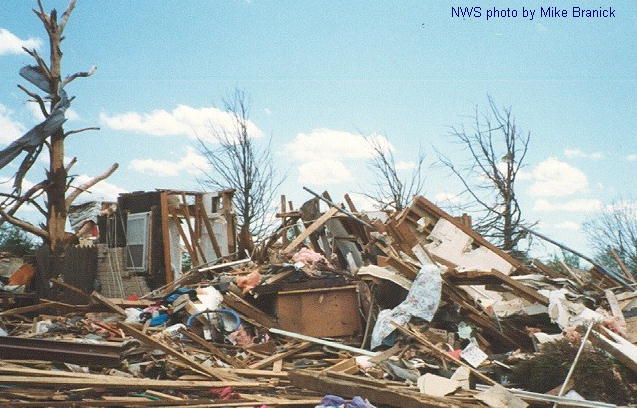
An Moore, Oklahoma home after a 1999 tornado. 
Photo credit: http://www.spc.noaa.gov/faq/tornado/f3.htm

Devastation and destruction by Sandy. The two images could have been from the same storm. 
Photo credit: http://darkroom.baltimoresun.com/wp-content/uploads/2012/10/AFPGetty-155063691.jpg

The Stafford Act is a federal law that holds the US Treasury responsible for 75 percent or more of the cost of repairing infrastructure damage (roads, bridges, etc) caused by a storm. While the Act provides incentives to rebuild, it does not encourage improved or revised storm preparations. As a NY Times article describes, “In many beachfront communities, the federal subsidies have helped people replace small beach shacks with larger, more valuable homes. That is a main reason the nation’s costs of storm recovery are doubling every decade.” (http://www.nytimes.com/2012/11/19/science/earth/as-coasts-rebuild-and-us-pays-again-critics-stop-to-ask-why.html?hp)


I’m torn. People should have the right to live where they want to live without the government dictating particular areas as “safe zones.” Anywhere can be hit by a devastating storm and require federal assistance. Such assistance must be available to those communities. No one asks for his or her home to be swept, blown or burned away.

Snowstorms will damage homes, bring down power lines and trees, and cripple transportation systems. As a New Englander, I face this reality ever winter. I feel no need to pack up and relocated to another part of the country just because I'm at risk to get a lot of snow. Thus can I understand why people with beachfront properties continue to rebuild their homes despite the risk of damage in a storm. 
Photo credit: http://www.punditmom.com/2010/02/snowpocalypse-part-deux-snowpocalypse-the-squeakuel

Yet I choose to live in a part of the country not typically threatened by coastal storms. Why should I be paying to repair the homes of people who take that risk? Why is it my financial responsibility to rebuild someone else’s beachfront vacation home only to pay again when it is damaged in the next hurricane? I should not have to pay for repeated rebuilds in high-risk areas. You choose to live on the beach then you pay for it when a hurricane hits.  You should pay for more than a ocean view when you build near the coast.


You live this close to the ocean and obviously you will have damage should an oceanfront storm rip through. If you take that risk, why do I my tax dollars have to pay for it? 
Photo credit: http://www.searchforcharlestonrealestate.com/images/a-sullivans%20beachfront%20crop.jpg

That being said, one could argue that because I reside in an area prone to snowstorms, any damage caused is my fiscal responsibility. I do not dispute this. In fact I accept it. But I know better than to assume the cost of storm recovery is solved so easily. I have yet to realize a satisfactory solution that balances individual and federal responsibility.


Should I approve my tax dollars to do that: repeatedly rebuild after a hurricane.


Tuesday, October 23, 2012

I Need My Tax Dollars to do That: Fight Rape on College Campuses


Last week, a former Amherst College student published an account of her personal struggle in dealing with the after affects of rape. Most upsetting, however, was the school’s response to her allegations against a graduating honor-roll senior. In other words, they blamed her, the victim, and tried to sweep the rape under the rug. Following her story’s publication in The Amherst Student, the school’s independently run newspaper, the article popped up all over the Facebook pages of Five College students furious at Amherst’s mishandling of an obvious crime.  With the administration facing such sharp criticism, the Amherst College president released a statement, vowing to fix the current system and provide better support for rape victims.

Yeah, because we all know how well schools uphold those promises when the issue at hand has the potential to tarnish a college’s precious statistics. They don’t.

Often a rape will get disguised and manipulated to show that the victim wanted it or consented to having sex. Last time I checked, no one asks to get raped. 
Photo credit: http://collegecandy.files.wordpress.com/2011/09/rape-2.jpg 

Rape on college campuses is a problem that extends way beyond the schools in the Pioneer Valley.  One in four women will be sexually assaulted on a college campus while one in eight women will be raped (http://abacus.bates.edu/admin/offices/scs/salt7.html). Yet 95% of attacks go unreported. A 2009 investigation by the Center for Public Integrity found that campus barriers including administration resistance, complicated and often incomplete judicial proceedings and social pressure were the main reasons so many rapes went unreported. (http://www.aauw.org/act/laf/library/assault_stats.cfm).

Based on the experiences of the Amherst student, it’s obvious that college administrations apply layer upon layer of red tape to prevent rape victims from seeking and achieving justice for their rapes. Rape is not a feature of the college experience any school wants to promote as part of its curriculum. No school wants to brag about the annual number of students raped and/or the number of students punished for having committed rape. But such statistics are not something schools should be allowed to dismiss.

One way to improve the system is change who oversees the investigation of rape accusations. Campus police should not be allowed to investigate rape cases based on conflict of interest. They represent and report to the school rather than acting as an advocate for the victim. Town police or a specific task force should be appointed to handle rape cases so that they can supersede any hang-ups attempted by an administration. That’s where my tax dollars come in. Such a change though only affects the handling of a rape after it has already occurred rather than trying to prevent its occurrence in the first place. That is something students must decide to change. But then again, maybe if college rapists were properly prosecuted, there would be fewer rapes to begin with.

I need my tax dollars to do that: Fight Rape on College Campuses